


If you’ve been researching GH secretagogues, you’ve likely come across two distinct peptide classes: GHRH analogues and GHRPs. They both influence growth hormone output, but through completely different pathways. This article breaks down how each class works, what separates them mechanistically, and why preclinical research consistently examines them together.
Growth Hormone Releasing Hormone (GHRH) is a peptide produced naturally in the hypothalamus. Its primary function is to signal the pituitary gland to produce and release growth hormone (GH).
This signalling pathway is called the somatotropic axis, which refers to the chain of hormonal communication between the hypothalamus, pituitary, and peripheral tissues. GHRH sits at the top of that chain. When it binds to GHRH receptors on the pituitary’s somatotroph cells, it triggers a well-documented cascade: cAMP levels rise, and GH is secreted into the bloodstream.
What makes GHRH significant in research is its specificity. It acts directly on a defined receptor class and produces a physiologically familiar GH pulse, one that mirrors the body’s natural secretion pattern. That predictability makes it a useful reference point in GH-related preclinical studies.
GHRPs, or Growth Hormone Releasing Peptides, work through a different mechanism entirely. They don’t target the GHRH receptor. Instead, they bind to the ghrelin receptor (GHSR-1a), a separate pathway that was only fully characterised in the late 1990s following the identification of ghrelin as its endogenous ligand.
Early GHRPs like GHRP-6 were synthesised before ghrelin was even discovered. Researchers observed that these synthetic peptides stimulated GH release through an unknown mechanism, later confirmed to be the ghrelin receptor. That discovery reshaped how the field understood GH regulation.
GHRPs amplify GH secretion by increasing the number and amplitude of GH pulses. They do this partly by suppressing somatostatin, the hormone responsible for inhibiting GH release. This somatostatin suppression is a key functional difference from GHRH analogues, which don’t directly modulate somatostatin activity.
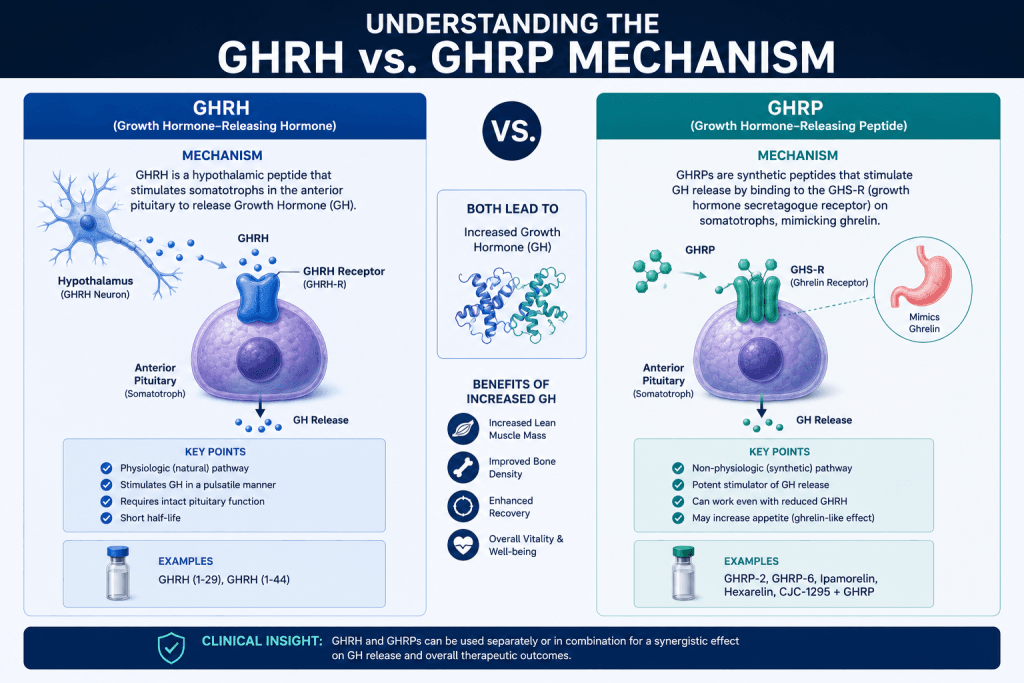
At the centre of GHRH vs GHRP research is a straightforward question: both peptide classes increase GH output, so what actually separates them?
The answer comes down to receptor target, timing, and how each interacts with GH’s regulatory system.
| GHRH Analogues | GHRPs | |
| Receptor | GHRH receptor (pituitary) | Ghrelin receptor (GHSR-1a) |
| Mechanism | Stimulates GH synthesis and release via cAMP | Amplifies GH pulse amplitude; suppresses somatostatin |
| Somatostatin Effect | No direct effect | Inhibits somatostatin release |
| GH Pulse Pattern | Extends and amplifies natural pulse | Increases pulse frequency and amplitude |
| Research Examples | CJC-1295, Tesamorelin | Ipamorelin, GHRP-2, GHRP-6 |
GHRH analogues extend or amplify the existing GH pulse. GHRPs create conditions that allow more pulses to occur, and larger ones at that. These are complementary actions, which is precisely why combination research is so prevalent.
Research has documented that combining a GHRH analogue with a GHRP produces GH release significantly greater than either compound used alone. This synergistic effect is one of the most consistently replicated findings in GH secretagogue research, with work by Bowers et al. contributing foundational evidence to this area.
The mechanism behind the synergy is logical once you understand each pathway. GHRH pushes the pituitary to secrete GH. A GHRP simultaneously suppresses somatostatin while activating a second, independent stimulatory pathway. The result is that both the accelerator and the brake are engaged in opposite directions at the same time, producing a substantially amplified response.
This is why combinations like CJC-1295 with Ipamorelin appear frequently in the research literature. They represent one GHRH analogue and one GHRP working through independent but complementary mechanisms.
CJC-1295 is one of the most studied GHRH analogues. It’s a modified form of the native GHRH(1-29) sequence, engineered for extended half-life through DAC (Drug Affinity Complex) technology. Where native GHRH degrades within minutes due to rapid enzymatic breakdown, CJC-1295 with DAC extends receptor occupancy considerably. That extended activity window makes it a practical choice in experimental protocols requiring sustained GHRH receptor stimulation.
Tesamorelin is another GHRH analogue with a well-developed research record. It uses a trans-2-hexenoic acid modification to resist enzymatic degradation. Its preclinical and clinical data set is more extensive than most analogues in this class, making it a useful reference compound in mechanism-of-action comparisons.
Both compounds act exclusively at the GHRH receptor, and neither suppresses somatostatin. That distinction is what makes pairing them with a GHRP mechanistically relevant in research settings.
Among the GHRPs, Ipamorelin occupies a distinct position in research due to its receptor selectivity. Unlike GHRP-6, which also stimulates appetite-related pathways and elevates cortisol and prolactin, Ipamorelin’s activity is more narrowly focused on the ghrelin receptor’s GH-stimulating function. That selectivity makes it easier to isolate GH-specific effects in experimental models. Biovantage Labs supplies Ipamorelin with batch-specific HPLC and MS verification for research use.
GHRP-2 sits between GHRP-6 and Ipamorelin in terms of selectivity. It produces strong GH stimulation but with more off-target receptor activity than Ipamorelin. GHRP-6 produces significant GH release alongside notable appetite stimulation, an effect that is itself an active area of research given ghrelin’s role in appetite regulation.
Understanding these distinctions matters when designing in-vitro research protocols. Selecting a GHRP isn’t simply about GH stimulation. It’s about which compound delivers the cleanest signal for the specific variable being measured.
GHRH analogues and GHRPs are structurally complex peptides. Synthesis quality directly affects their receptor-binding activity and therefore the validity of any experimental data derived from their use.
A compound with 90% purity and 10% unknown impurities isn’t just a lower-grade product. In a research context, it’s a confounding variable. Any observed effect could theoretically be attributed to the impurity fraction rather than the target compound.
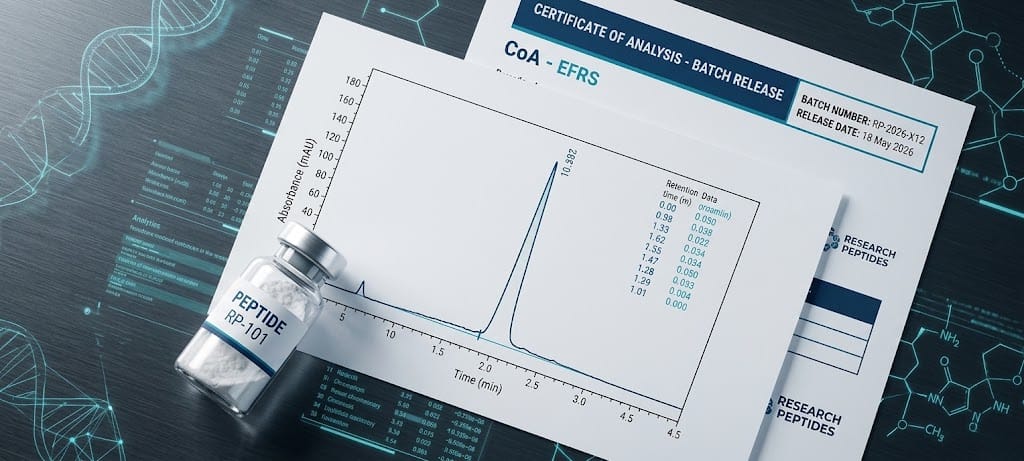
This is why batch-specific COAs, not generic or reused certificates, are the minimum standard for legitimate research sourcing. HPLC data confirms purity and identity. Mass spectrometry (MS) confirms molecular weight and sequence. Both together provide confidence that the compound in the vial matches what the label states.
Domestic sourcing adds a further layer of reliability. International suppliers introduce cold-chain risk and customs delays that can compromise compound integrity before research even begins. All Biovantage Labs compounds are fulfilled from within Canada, climate-controlled, and supported by downloadable batch-specific COAs on every product page.
If your protocols involve GHRH analogues or GHRPs, compound purity is the foundation of reproducible results. Biovantage Labs supplies CJC-1295, Ipamorelin, and a full range of research peptides with HPLC and MS batch verification, domestic Canadian fulfillment, and downloadable COAs on every product page.
Browse the full Biovantage Labs
GHRH analogues bind to the GHRH receptor on the pituitary and directly stimulate GH synthesis and release. GHRPs bind to the ghrelin receptor (GHSR-1a) and amplify GH output through a separate pathway, including suppression of somatostatin, the hormone that inhibits GH release. They act through entirely different receptors.
Ipamorelin binds specifically to the ghrelin receptor’s GH-stimulating pathway with minimal activity at receptors responsible for cortisol, prolactin, and appetite signalling. Compounds like GHRP-6 stimulate GH but also activate these secondary pathways, which can complicate experimental interpretation. Ipamorelin’s narrower activity profile makes it a cleaner variable in research settings.
Synergy refers to the finding that combining a GHRH analogue with a GHRP produces GH stimulation greater than the sum of each compound used alone. This occurs because the two compounds act through independent, complementary mechanisms: one stimulating directly at the pituitary, the other removing the somatostatin-mediated inhibitory brake simultaneously.
Native GHRH(1-29) has a very short half-life and is rapidly degraded by plasma enzymes within minutes. CJC-1295 is engineered with a DAC modification that binds the compound to albumin in the bloodstream, extending its active half-life significantly. This makes it more practical for experimental protocols requiring prolonged GHRH receptor stimulation.
Impurities in a peptide compound are uncontrolled variables. If a sample contains unknown synthesis byproducts, any experimental observation could be confounded by that fraction rather than the target compound’s activity alone. Batch-specific HPLC and MS verification confirm that a compound’s identity, sequence, and purity match its label.
Research Use Only Disclaimer: All compounds referenced in this article are supplied strictly for in-vitro laboratory and independent research purposes only. They are not approved for human use, human consumption, or therapeutic application. This content does not constitute medical advice. All research must be conducted in compliance with applicable regulations, including Health Canada guidelines.