
The comparison between oral vs injectable peptides comes down to one biological problem: the digestive system breaks down most peptides before they can be absorbed. This article explains why that happens, what new delivery technologies are being studied, and what this means for in vitro peptide research in Canada.
Peptides are short chains of amino acids, the same building blocks found in proteins. When one is swallowed, the GI tract does exactly what it is designed to do: break it apart. Enzymes target peptide bonds, and the compound is dismantled before it reaches its research target. The GI tract evolved to prevent foreign molecules from entering systemic circulation, and most research peptides get caught by that process.
Injectable administration sidesteps this entirely. Delivering the compound directly into tissue or the bloodstream avoids the GI environment. That is why parenteral routes have dominated peptide research for decades, and why oral delivery remains one of the harder problems in pharmaceutical formulation science.
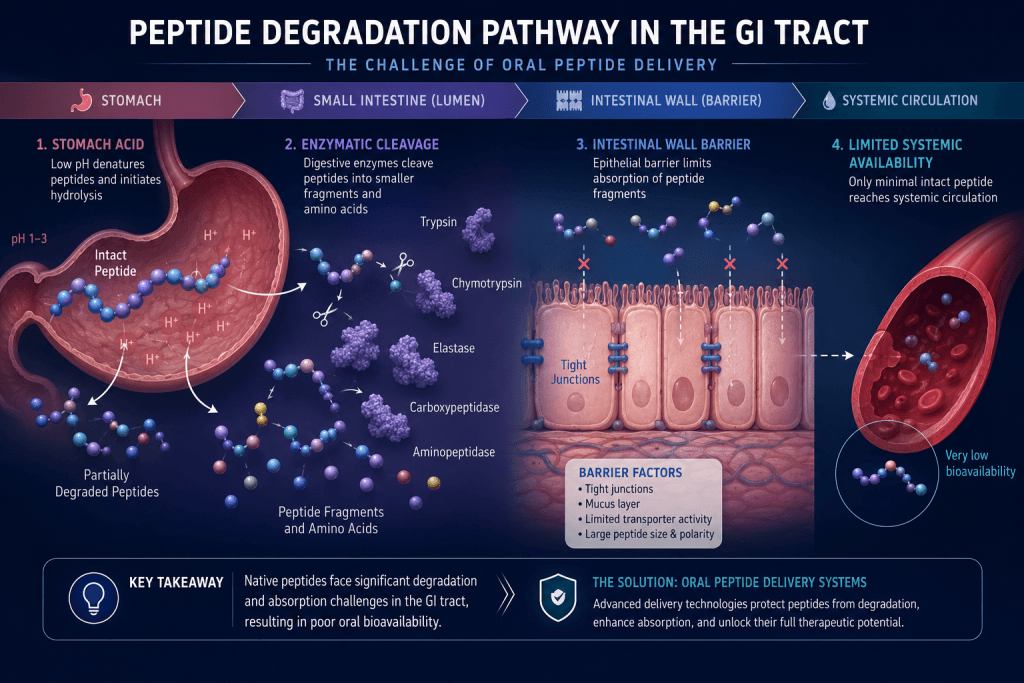
The GI tract does not present one obstacle to oral peptides; it presents three, each at a different stage of the absorption process. A review published in PubMed covering strategies for oral peptide delivery summarises these barriers and the limited success that has been achieved in overcoming them.
Proteolytic enzymes, pepsin in the stomach, trypsin and chymotrypsin in the small intestine, are specifically designed to cleave peptide bonds. A peptide that survives the acid environment of the stomach faces a second round of enzymatic breakdown further along the GI tract. Very few research peptides make it through intact.
Even if a peptide avoids enzymatic degradation, it still needs to cross the intestinal mucosa, the thick, protective lining of the gut wall. Most research peptides are hydrophilic (water-attracting), which makes crossing the lipid-rich cell membranes of the gut wall extremely difficult. The bigger the peptide molecule, the harder this crossing becomes.
A third layer of difficulty comes from efflux transporter proteins, particularly P-glycoprotein. These proteins actively pump foreign molecules back into the intestinal lumen before they can enter the bloodstream. Many peptide-like structures are recognised as targets for efflux, adding another layer of loss even when the first two barriers are partially overcome.
Together, these three mechanisms mean that oral peptide bioavailability for most research compounds is extremely low, typically below 1–2% even under optimised conditions.
Several formulation approaches are actively being studied. None is yet standard practice for most research peptides, but the science is advancing.
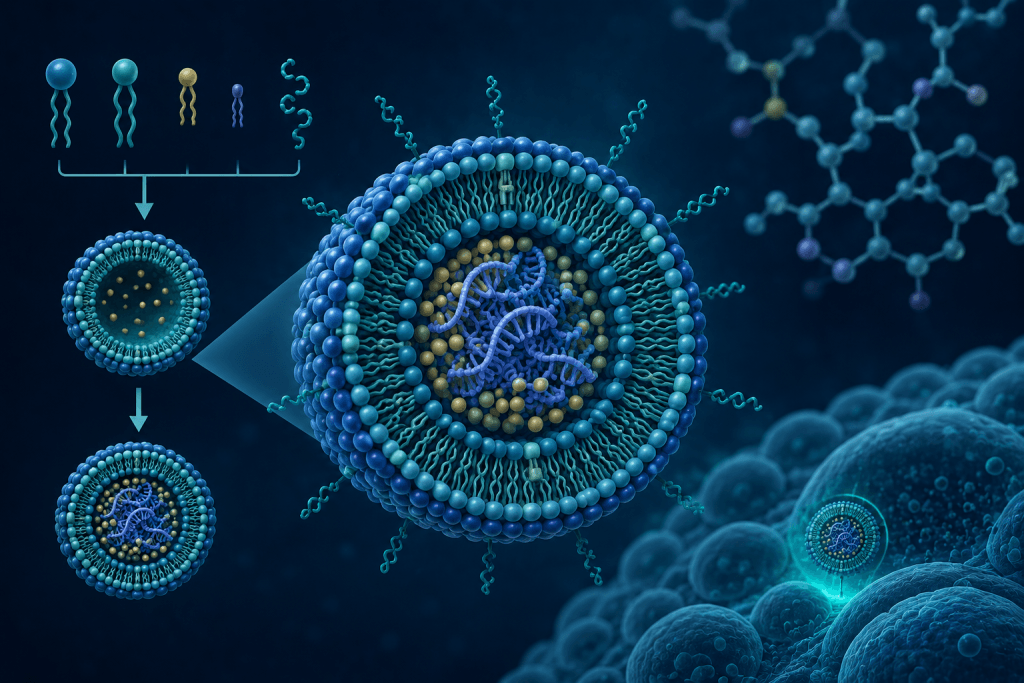
Enclosing a peptide inside a lipid nanoparticle shields it from enzymatic attack and improves gut wall crossing. Lipid particles are absorbed through fat-uptake pathways that partially bypass enzymatic exposure. A review via the NIH documents how solid lipid nanoparticles improve absorption and protect peptide cargo from degradation.
Permeation enhancers temporarily open tight junctions in the gut wall or increase transcellular passage. The most studied example is SNAC, co-formulated with semaglutide to produce the first approved oral GLP-1 receptor agonist. A review on SNAC and oral semaglutide shows how SNAC suppresses pepsin activity and enables transcellular absorption, though oral bioavailability remains below 1%.
Cyclic peptides have a ring structure that resists enzymatic cleavage. The enzymes that cut linear peptide bonds struggle to recognise cyclic geometry, giving these compounds a natural stability advantage for oral delivery research.
For researchers choosing between delivery formats, the differences go beyond convenience. The table below covers the key variables in a research context.
| Factor | Injectable Peptides | Oral Peptides |
| Bioavailability | High; reaches target reliably | Low to variable; enzymatic and mucosal barriers reduce absorption significantly |
| Reproducibility | High, predictable concentration, easier to standardise | Low absorption variability complicates consistent compound levels |
| Handling | Requires reconstitution and sterile preparation | Simpler in principle; no reconstitution for oral formats |
| Research validation | Extensive; most peptide literature uses injectable formats | Limited; oral activity validated for a few peptides (e.g., BPC-157) |
| Delivery barrier | Bypasses the GI tract entirely | Enzymatic degradation, mucosal penetration, efflux transporters |
| Best suited for | Controlled in-vitro work requiring reproducibility | Exploratory oral formulation research |
Injectable formats remain the standard for in-vitro peptide research. BPC-157 and TB-500 have an extensive preclinical literature base built on parenteral administration.
| Health Canada Advisory: BPC-157 and TB-500 are named in Health Canada public advisories. These compounds are sold for in-vitro research use only. All research must comply with applicable regulations. |
A small number of peptides have demonstrated meaningful oral activity in preclinical research or are in active pharmaceutical development with oral formulations.
Here is where the current research stands:
The current evidence base is clear: for most research peptides in common use, injectable administration produces more reproducible, more validated results than oral delivery.
That may not always be true. The three areas to watch are:
Researchers following this space should track formulation literature, not just compound-specific studies. The delivery problem is increasingly a chemistry and materials science challenge.
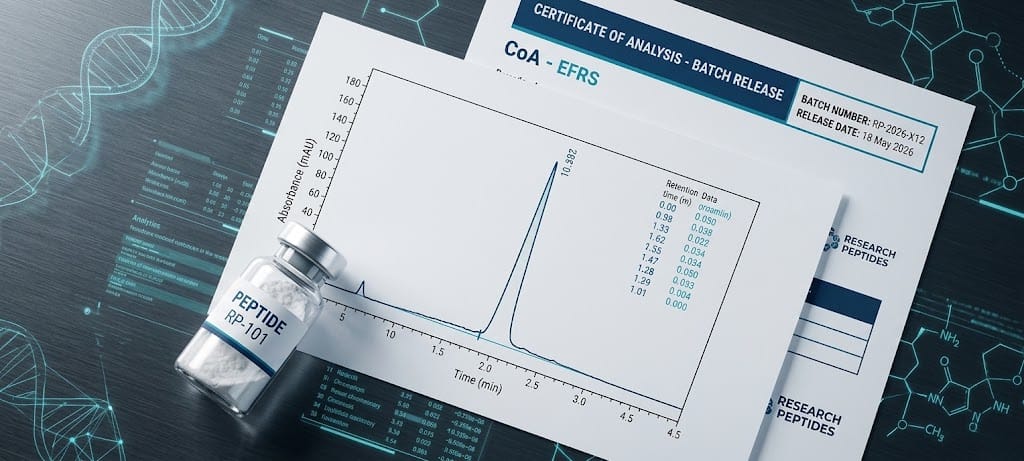
Regardless of delivery format, using compounds with confirmed purity and a current batch COA remains the most important quality control step for reproducible in-vitro research.
The gap between oral vs injectable peptides comes down to one unsolved problem: how do you protect a fragile molecule through one of the most aggressive chemical environments in the body?
Injectable administration bypasses that environment entirely, which is why it remains the standard. Oral delivery has obvious practical advantages, but they only matter if the compound arrives at its target intact. For most peptides currently in use, that threshold has not been reliably reached.
Until then, the most rigorous research relies on purity-verified compounds in validated delivery formats.
Every compound at Performance Peptides Canada is HPLC and MS-tested at 99%+ purity, with batch-specific COAs available for download. No international delays. No cold-chain uncertainty.→ View batch-verified peptides at the Performance Peptides Canada shop
Most research peptides are not reliably absorbed orally. Digestive enzymes break down peptide bonds before the compound can cross the intestinal wall, meaning very little reaches circulation intact. A small number of peptides, particularly cyclic structures or those formulated with protective carriers, show better oral stability, but this remains the exception rather than the standard in current research.
The digestive system is specifically built to break peptides and proteins into amino acids. Enzymes like pepsin and trypsin efficiently cleave peptide bonds, and the acid environment of the stomach further destabilises many compounds. For a peptide to survive oral administration, it needs either protection from a delivery system (like a lipid nanoparticle) or structural resistance to enzymatic cleavage, a property that few standard research peptides possess.
Not for most research peptides currently in use. Injectable administration delivers the compound directly into the bloodstream or target tissue, bypassing GI degradation entirely. Even for peptides showing some oral activity, bioavailability is typically a fraction of what injectable administration achieves. Researchers relying on consistent, reproducible compound concentrations will generally find injectable formats better suited to controlled in-vitro work.
Smaller peptides are generally more tractable than larger ones, though size alone is not decisive. Cyclic peptides are inherently more resistant to enzymatic cleavage due to their ring structure. Peptides that are naturally lipophilic cross the gut wall more easily. Formulation also matters significantly; the same peptide can behave very differently depending on whether it is encapsulated in a lipid carrier or co-administered with a permeation enhancer.
BPC-157 has preclinical data on oral activity in animal models, which sets it apart from most research peptides. However, the oral and injectable bioavailability figures are not directly comparable, and injectable administration remains the more validated route. TB-500, IGF-1 LR3, Ipamorelin, and CJC-1295 have their primary research base in injectable formats, and oral delivery for these compounds is not yet supported by peer-reviewed validation.
| Research Use Only — Disclaimer All compounds referenced in this article, including BPC-157, TB-500, IGF-1 LR3, Ipamorelin, and CJC-1295, are sold strictly for in-vitro laboratory and independent research use only. They are not approved for human consumption, therapeutic use, or clinical application. Health Canada has issued public advisories regarding BPC-157, TB-500, CJC-1295, and Ipamorelin. This content does not constitute medical advice and should not be interpreted as an endorsement of human use. All research must be conducted in compliance with applicable Canadian regulations. |