
Have a question about a compound, reconstitution protocol, or COA? Our analytical team responds within one business day.

Researchers studying tissue repair and vascular biology have increasingly turned to angiogenesis peptides, specifically BPC-157 and TB-500, to understand how new blood vessels form in preclinical models. This guide breaks down what angiogenesis is, how each compound interacts with vascular pathways in research settings, where they overlap, and where they differ.
Angiogenesis is the process by which new blood vessels grow from existing ones. It plays a central role in wound healing, tissue regeneration, and recovery from injury, making it one of the most studied processes in biomedical research.
Without adequate blood vessel formation, tissue can’t receive the oxygen and nutrients it needs to repair itself. This is why angiogenesis is a core focus in studies on muscle injury, tendon damage, and soft tissue recovery.
Peptide researchers are particularly interested in compounds that appear to interact with angiogenic signalling pathways. BPC-157 and TB-500 are two of the most widely studied angiogenesis peptides in preclinical literature, and understanding what each one does at a mechanistic level helps clarify why they’re often researched together.
BPC-157 (Body Protection Compound-157) is a synthetic pentadecapeptide derived from a protein found in gastric juice. In preclinical models, it has shown a consistent ability to upregulate vascular endothelial growth factor (VEGF), one of the primary signalling proteins that drives the formation of new blood vessels.
VEGF is the body’s primary angiogenic trigger. When VEGF signalling is active, endothelial cells, the cells that line blood vessels, begin to proliferate and migrate, laying the groundwork for new capillary formation.
Preclinical studies have observed that BPC-157 appears to increase VEGF receptor expression in damaged tissue, which may explain the accelerated vascular repair noted in animal wound models. A study published in the Journal of Molecular Medicine demonstrated that BPC-157 upregulates VEGFR2 expression and activates the VEGFR2-Akt-eNOS signalling pathway in rat hind limb ischemia models and in-vitro endothelial cell assays.
BPC-157 has also been associated with nitric oxide (NO) pathway activity. Nitric oxide plays a vasodilatory role; it relaxes blood vessel walls, improving local blood flow in the study site. This dual interaction with both VEGF and NO pathways makes BPC-157 a compound of significant interest in vascular repair research.
Research-use-only notice: BPC-157 is sold strictly for in-vitro and laboratory research use. It is not approved for human consumption. Health Canada has specifically named BPC-157 in public advisories. All research must be conducted in compliance with applicable regulations.
If you’re sourcing BPC-157 for laboratory research, batch-verified BPC-157 with HPLC and MS documentation is available from Performance Peptides Canada.
TB-500 is a synthetic version of Thymosin Beta-4 (Tβ4), a naturally occurring peptide found in nearly all human and animal cells. Its primary known function is actin regulation, but its downstream effects on blood vessel formation have made it a subject of serious scientific interest.
Actin is a structural protein that endothelial cells use to change shape and migrate. When blood vessel repair begins, endothelial cells must physically move through tissue to form new capillaries, and they rely on actin polymerisation to do it.
By promoting actin polymerisation, TB-500 supports the structural mechanics of angiogenesis at the cellular level. A peer-reviewed review published in the journal Angiogenesis examined how Tβ4 regulates blood vessel formation, including its role in endothelial cell migration, wound healing, and cardiovascular tissue repair.
TB-500 has also been studied for its interaction with VEGF expression. Some preclinical models suggest Tβ4 may upregulate VEGF independently of BPC-157’s pathway, meaning the two compounds could work through complementary, not identical, mechanisms. Research catalogued on PubMed documents Thymosin Beta-4’s angiogenic activity across multiple wound repair and tissue models, including effects on cell migration and vascular density in both normal and aged rodents.
Research-use-only notice: TB-500 is sold strictly for in-vitro and laboratory research use. It is not approved for human consumption. Health Canada has specifically named TB-500 in public advisories.
Researchers can access batch-verified TB-500 with downloadable COAs through Performance Peptides Canada’s domestic supply chain.
Understanding the distinction between these two angiogenesis peptides is important for research design. They’re not interchangeable; they act through different primary mechanisms, even though both ultimately influence blood vessel formation.
| BPC-157 | TB-500 | |
| Primary mechanism | VEGF upregulation, NO pathway | Actin polymerisation, endothelial cell migration |
| Secondary vascular effects | Nitric oxide vasodilation | VEGF upregulation (secondary) |
| Research focus | Tendon, gut, and muscle tissue repair | Wound healing, cardiac tissue, connective tissue |
| Origin | Synthetic peptide (gastric protein fragment) | Synthetic Thymosin Beta-4 fragment |
The overlap between BPC-157 and TB-500 is most visible at the outcome level; both have been associated with enhanced vascular density in preclinical wound models. But the upstream pathways are distinct, which is why many researchers studying angiogenesis in tissue repair examine them both within the same experimental framework.
Compound purity is not a minor variable in angiogenesis research; it’s a fundamental one. Studies examining VEGF expression or endothelial cell migration depend on compounds that are what they claim to be, at the concentration stated.
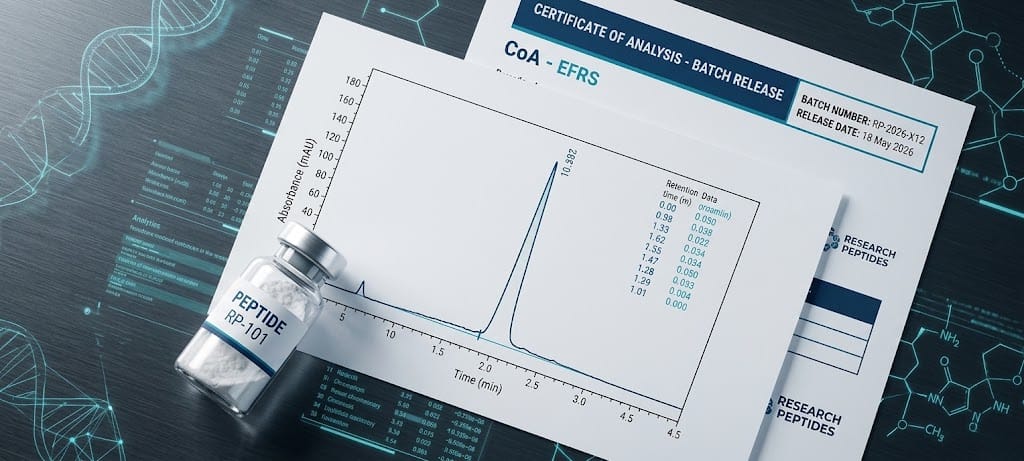
Low-purity peptides introduce confounds that are difficult to isolate after data collection. This is why batch-specific Certificates of Analysis (COAs) with HPLC and mass spectrometry data are the minimum acceptable documentation standard for research-grade compounds.
Performance Peptides Canada supplies research peptides Canada researchers can verify. Every batch undergoes independent third-party HPLC and MS testing, with downloadable COAs publicly available per product. All orders ship domestically, eliminating customs delays and cold-chain risks that compromise compound integrity during transit.
For guidance on reading and validating a COA before you order, the research peptide COA guide covers what to look for in HPLC data, purity thresholds, and red flags in supplier documentation.
Browse the full range of third-party verified research peptides available for domestic Canadian delivery.
BPC-157 and TB-500 represent two of the best-characterised angiogenesis peptides in current preclinical literature. Their mechanisms are distinct: BPC-157 operates primarily through VEGF and nitric oxide pathways, while TB-500 works through actin-mediated endothelial cell migration, but both converge on the same downstream outcome: enhanced blood vessel formation in tissue repair models.
Researchers designing studies in this space should account for these mechanistic differences when selecting compounds or designing combination protocols. The quality of source material is equally critical; purity documentation, batch traceability, and domestic supply chain integrity all affect the reliability of experimental results.
All compounds from Performance Peptides Canada are supplied strictly for in-vitro research use in compliance with Health Canada guidelines.
The Performance Peptides Canada team is available to answer sourcing and documentation questions before you commit. If you need batch-specific data for a particular compound or want to confirm availability for your research timeline, get in touch through the contact page, and the team will respond promptly.
Angiogenesis is the biological process of forming new blood vessels from existing ones. In research contexts, it’s a key outcome measure in wound healing and tissue repair studies because new capillary growth directly determines how well damaged tissue receives oxygen and nutrients during recovery. Compounds that interact with angiogenic signalling pathways, such as VEGF upregulation or actin-based endothelial cell migration, give researchers a measurable mechanism to study in preclinical models.
In preclinical studies, BPC-157 has been observed to upregulate VEGF receptor expression and activate nitric oxide pathways. Both of these mechanisms support new blood vessel formation in damaged tissue. A preclinical study in rat wound and tendon models documented measurable increases in vascular density following BPC-157 administration under laboratory conditions.
TB-500 is a synthetic peptide derived from the active region of Thymosin Beta-4 (Tβ4). It shares the actin-regulatory properties of the full Tβ4 protein and has been studied for similar effects on endothelial cell migration and blood vessel formation. It is not identical to the full Tβ4 sequence but is considered a functional research analogue in preclinical literature.
Yes, because they act through distinct primary mechanisms, some researchers examine them within the same experimental framework to study whether their angiogenic effects are additive. Study design should account for each compound’s independent pathway activity to avoid confounding variables.
Performance Peptides Canada supplies batch-specific, HPLC and MS-verified BPC-157 and TB-500 with downloadable COAs for each production batch. All compounds are fulfilled domestically within Canada. Products are sold strictly for in-vitro research use in compliance with Health Canada guidelines.
Research-Use-Only Disclaimer
All products sold by Performance Peptides Canada under the Biovantage Labs brand are intended strictly for in-vitro laboratory and independent research use. These compounds are not approved for human consumption, therapeutic use, or veterinary administration. Health Canada has issued public advisories regarding BPC-157 and TB-500. Purchasers are solely responsible for compliance with all applicable federal and provincial regulations.
Experience unparalleled research integrity with 99%+ purity guaranteed via third-party HPLC testing, supported by 100% domestic Canadian fulfillment and expert technical guidance for every reconstitution and storage inquiry.