Description
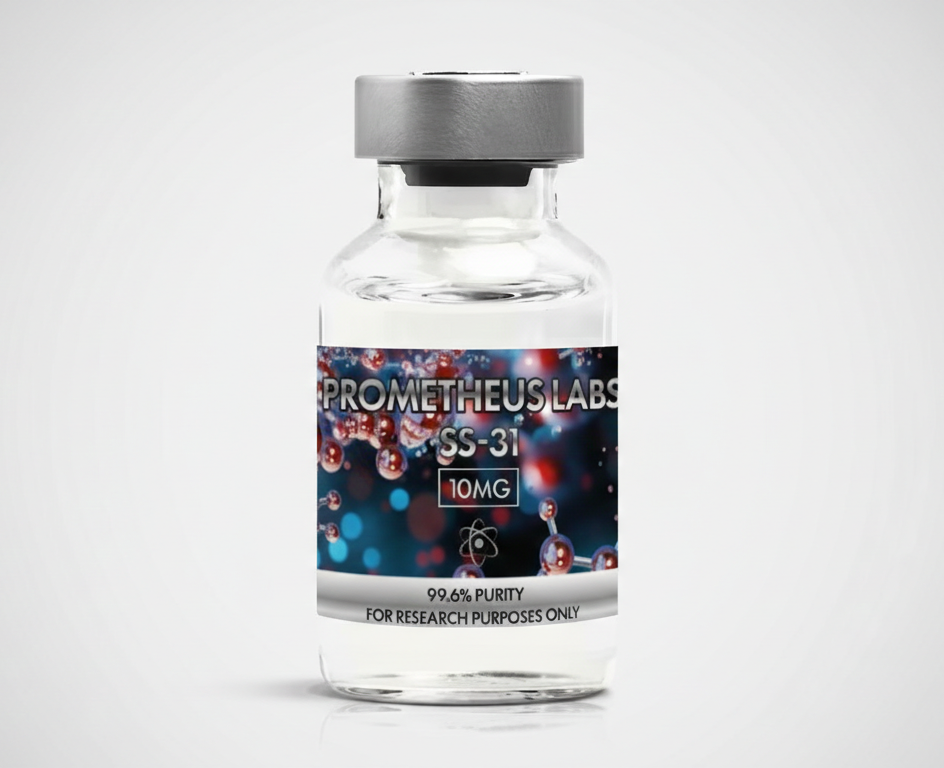
SS-31, also known as Elamipretide or Bendavia, is a synthetic, water-soluble tetra-peptide (D-Arg-2′,6′-Dmt-Lys-Phe-NH2). Unlike general antioxidants that distribute broadly across the cell, SS-31 is uniquely cell-permeable and selectively localizes to the inner mitochondrial membrane (IMM). It is a primary entity for investigating the restoration of mitochondrial bioenergetics and the mitigation of ROS (Reactive Oxygen Species) at their source.
Performance Peptides Canada offers SS-31 10mg vials at 99%+ HPLC-verified purity. Our domestic fulfillment ensures that researchers receive high-stability ligands optimized for studying mitochondrial dysfunction and cardiolipin-dependent signaling in Canada.
Technical Specifications & Chemical Profile
Our SS-31 is synthesized to meet rigorous analytical standards:
- Molecular Formula: C32H49N9O5
- Molecular Weight: 639.8 g/mol
- Sequence: D-Arg-Dmt-Lys-Phe-NH2 (where Dmt is 2′,6′-dimethyltyrosine)
- Purity: ≥99.0% (Verified via HPLC/MS)
- CAS Number: 736992-21-5
- Form: Lyophilized white powder
Primary Research Mechanisms & Bioenergetics
SS-31 is distinguished by its interaction with mitochondrial lipids, particularly cardiolipin.
1. Cardiolipin Stabilization
SS-31 binds selectively to cardiolipin, a unique phospholipid located in the inner mitochondrial membrane. Cardiolipin is essential for the structural integrity of the cristae and the optimal function of the electron transport chain (ETC). By stabilizing cardiolipin, SS-31 prevents its oxidation and maintains mitochondrial “supercomplex” formation, which is vital for efficient ATP production.
2. Mitigation of Mitochondrial ROS
Because SS-31 localizes directly to the site of electron leakage, it is highly effective at neutralizing superoxide and hydroxyl radicals before they can damage mitochondrial DNA or proteins. Researchers utilize SS-31 to study the prevention of “ROS-induced ROS release,” a cycle that leads to cellular senescence and apoptosis.
3. ATP Synthesis & Metabolic Recovery
In research models of ischemia and age-related decline, SS-31 has been shown to improve the efficiency of the Electron Transport Chain. By optimizing the flow of electrons through Complexes I-IV, it helps restore the mitochondrial membrane potential and enhances the oxygen consumption rate (OCR), leading to increased ATP synthesis without increasing oxidative stress.
Reconstitution & Stability Benchmarks
SS-31 is a relatively robust tetra-peptide, but should be handled with standard precision:
- Reconstitution: Recommended diluents are Bacteriostatic Water or 0.9% Sterile Saline.
- Solubility: Highly soluble in aqueous solutions. Gently swirl to dissolve; do not agitate.
- Storage: Store the lyophilized powder at -20°C. Once reconstituted, it should be kept refrigerated at 2°C to 8°C.
Stability Data
| Storage Condition |
Physical State |
Estimated Stability |
| -20°C (Freezer) |
Lyophilized (Dry) |
24+ Months |
| 2°C to 8°C (Fridge) |
Lyophilized (Dry) |
12 Months |
| 2°C to 8°C (Fridge) |
Reconstituted |
14–21 Days |
SS-31 Research FAQ
Q: How does SS-31 differ from standard antioxidants like Vitamin C?
A: Standard antioxidants are distributed throughout the cytoplasm and often fail to penetrate the mitochondria in meaningful concentrations. SS-31 is specifically designed to accumulate in the inner mitochondrial membrane, targeting the exact source of oxidative stress.
Q: Can SS-31 be studied alongside NAD+?
A: Yes. Many researchers investigate the synergy between SS-31 (which optimizes the hardware of the mitochondria) and NAD+ (which provides the fuel for the enzymes) to study comprehensive metabolic restoration.
Q: Is this product shipped from within Canada?
A: Yes. Performance Peptides Canada provides domestic shipping for all SS-31 orders. This ensures that your research material is not exposed to the unregulated temperatures or delays associated with international customs.
Only logged in customers who have purchased this product may leave a review.





Reviews
There are no reviews yet.