Description
CJC-1295 with DAC (Drug Affinity Complex) is a synthetic 30-amino acid peptide analog of Growth Hormone-Releasing Hormone (GHRH). The addition of the DAC moiety is a revolutionary modification that allows the peptide to covalently bond to circulating albumin after administration. This technology extends the biological half-life of the peptide from approximately 30 minutes to over 6–8 days, enabling researchers to study sustained, rather than pulsatile, growth hormone elevation.
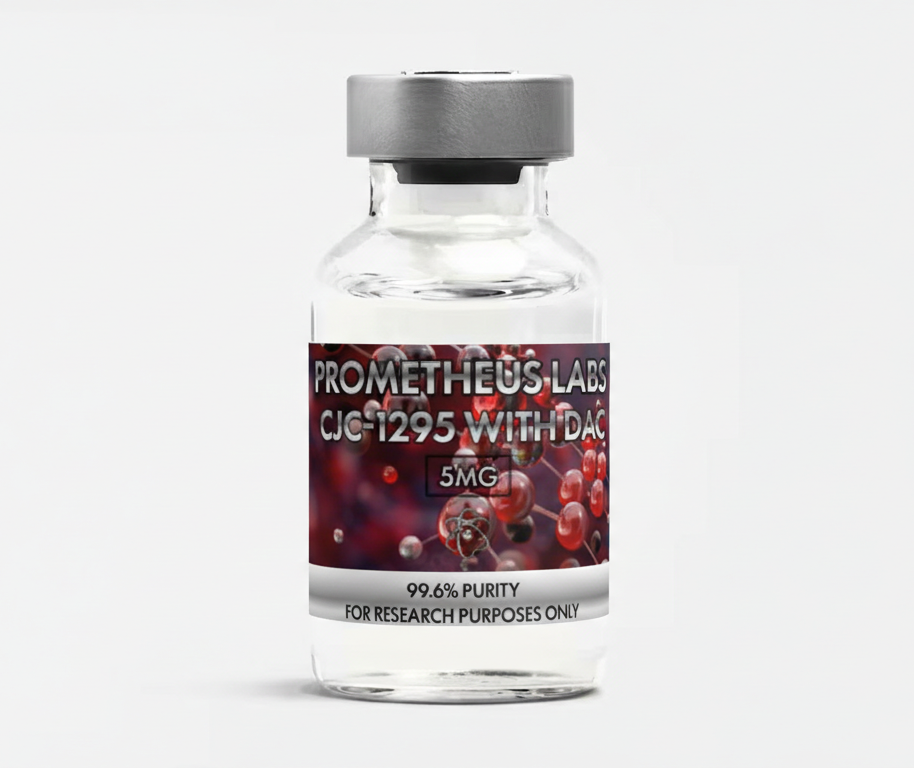
Prometheus Labs offers 5mg CJC-1295 with DAC vials at 99%+ HPLC-verified purity. Our domestic fulfillment ensures that researchers receive laboratory-grade ligands with the chemical stability required for long-term somatotropic signaling and IGF-1 studies.
Technical Specifications & Chemical Architecture
Our CJC-1295 with DAC is synthesized to the following analytical standards:
- Molecular Formula: C152H252N44O42
- Molecular Weight: 3367.97 g/mol
- Sequence: Tyr-D-Ala-Asp-Ala-Ile-Phe-Thr-Gln-Ser-Tyr-Arg-Lys-Val-Leu-Ala-Gln-Leu-Ser-Ala-Arg-Lys-Leu-Leu-Gln-Asp-Ile-Leu-Ser-Arg-Lys(Maleimidopropionyl)-NH2
- Purity: ≥99.0% (Verified via HPLC/MS)
- Form: Lyophilized white powder
Primary Research Mechanisms & GHRH Signaling
CJC-1295 with DAC is a cornerstone of endocrine research, particularly regarding the Growth Hormone-Releasing Hormone Receptor (GHRHR).
1. Sustained Somatotroph Stimulation
Unlike the “No DAC” version, which mimics the natural pulse of GHRH, the DAC-modified version provides a continuous stimulus to the pituitary somatotrophs. This allows researchers to examine the effects of a “GH bleed”, a sustained increase in basal growth hormone levels that leads to a steady rise in IGF-1 (Insulin-like Growth Factor 1).
2. Albumin Conjugation (The DAC Effect)
The Drug Affinity Complex (DAC) consists of a maleimide group that reacts specifically with the thiol group of cysteine-34 on human serum albumin. By “hitching a ride” on albumin, the peptide is protected from rapid enzymatic degradation and renal filtration. This mechanism is an essential area of study for researchers interested in peptide drug delivery and half-life extension.
3. Metabolic & Tissue Proliferation Studies
Researchers utilize CJC-1295 with DAC to investigate:
- Lipolysis: The breakdown of adipose tissue through GH-mediated pathways.
- Protein Synthesis: Upregulation of nitrogen retention and cellular repair.
- Myogenesis: The proliferation of skeletal muscle cells via IGF-1 signaling.
Reconstitution & Stability Benchmarks
Given its long-acting nature, maintaining the purity of the reconstituted solution is vital for experimental consistency:
- Reconstitution: Recommended diluent is Bacteriostatic Water (preferred for multi-dose vials) or 0.9% Sterile Saline.
- Storage: Store lyophilized powder at -20°C. Once reconstituted, store at 2°C to 8°C.
- Stability: Due to the complexity of the DAC modification, reconstituted solutions should be used within 7–10 days for maximum efficacy. Protect from light exposure at all times.
Stability Data
| Storage Condition |
Physical State |
Estimated Stability |
| -20°C (Freezer) |
Lyophilized (Dry) |
24 Months |
| 2°C to 8°C (Fridge) |
Lyophilized (Dry) |
12 Months |
| 2°C to 8°C (Fridge) |
Reconstituted |
7–10 Days |
CJC-1295 with DAC Research FAQ
Q: What is the main difference between CJC-1295 with DAC and without DAC?
A: The primary difference is the half-life. CJC-1295 No DAC (Modified GRF 1-29) has a half-life of about 30 minutes and is used for pulsatile GH research. CJC-1295 with DAC has a half-life of about 8 days and is used for research involving sustained GH and IGF-1 elevation.
Q: Can CJC-1295 with DAC be studied alongside Ipamorelin?
A: Yes. This is a common research protocol used to observe the synergy between a GHRH (CJC-1295) and a GHRP (Ipamorelin). The combination is often studied for its ability to maximize the total volume of growth hormone release.
Q: Is your CJC-1295 third-party tested?
A: Every batch of CJC-1295 with DAC at Prometheus Labs is verified to be 99%+ pure via HPLC. We also provide Mass Spectrometry data to confirm the presence of the DAC moiety.
Only logged in customers who have purchased this product may leave a review.





Reviews
There are no reviews yet.