Description
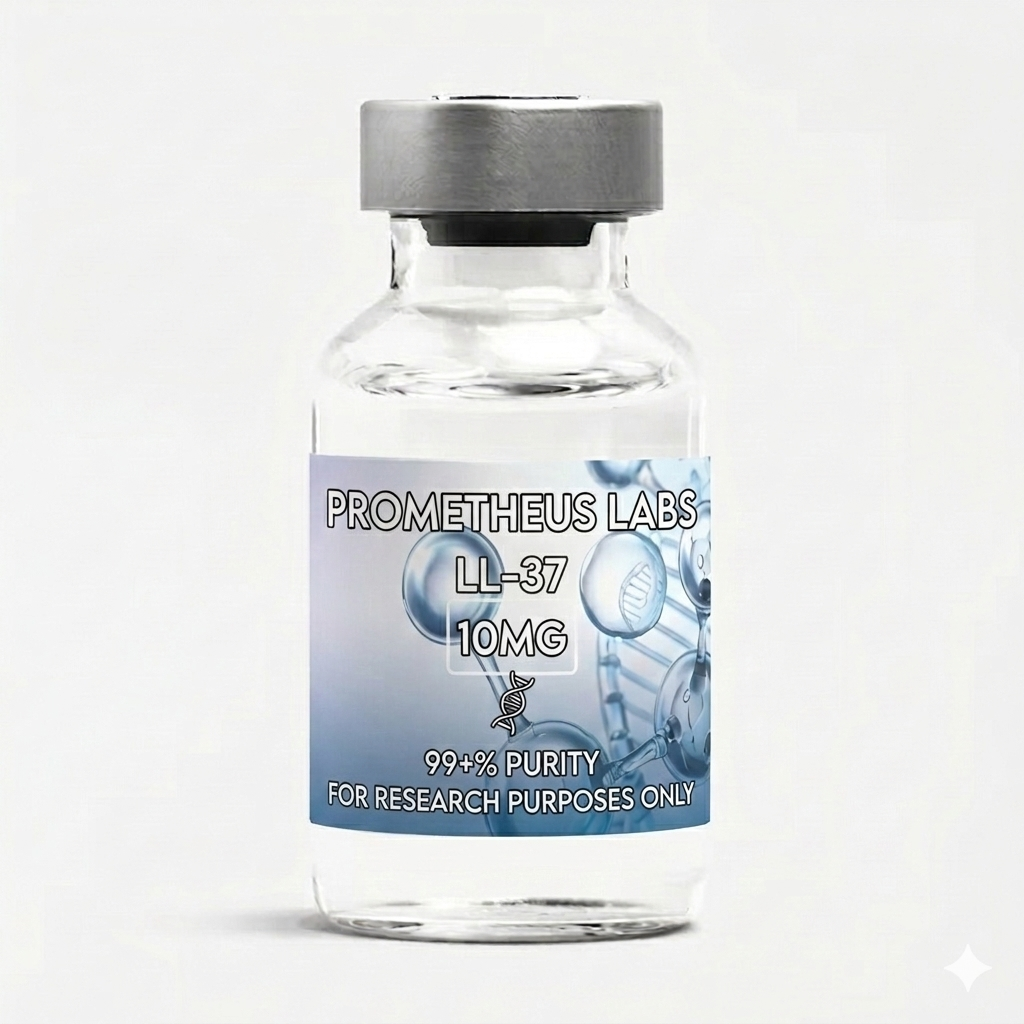
LL-37 is the only cathelicidin-family antimicrobial peptide identified in humans, a 37-residue, amphipathic alpha-helical fragment cleaved from the C-terminal domain of the precursor protein hCAP18. Prometheus Labs provides LL-37 at 10mg per vial, 99+% purity confirmed by batch-specific HPLC and Mass Spectrometry analysis, as a lyophilized compound for use in controlled laboratory settings.
Molecular Profile and Chemical Specifications
| Specification |
Detail |
| Molecular Formula |
C205H340N60O59 |
| Molecular Weight |
~4,493.3 Da |
| Sequence |
LLGDFFRKSKEKIGKEFKRIVQRIKDFLRNLVPRTES |
| Purity |
≥99+% (HPLC/MS verified) |
| Physical Form |
Lyophilized white powder |
| Vial Size |
10mg |
Primary Research Mechanisms
Membrane Permeabilization and Direct Antimicrobial Activity
LL-37 is studied for its ability to insert into and disrupt the lipid bilayers of bacterial membranes, a mechanism attributed to its amphipathic helical structure. Research in this area examines LL-37’s broad-spectrum activity against both gram-positive and gram-negative bacterial models.
FPR2 Receptor Signalling and Immune Cell Chemotaxis
LL-37 is investigated for its interaction with the formyl peptide receptor 2 (FPR2) on neutrophils, monocytes, and T cells, a primary research pathway for studying innate immune cell recruitment to sites of infection or tissue injury.
This innate immune signalling role is distinct from, but complementary to, adaptive immune research on peptides such as Thymosin Alpha-1, which is studied for its influence on T-cell maturation and function.
Wound Healing and Re-Epithelialization Research
LL-37 is studied for its influence on keratinocyte migration and angiogenesis, a research entity of interest in models examining the intersection of host-defence signalling and tissue repair.
Research examining LL-37’s role in keratinocyte migration parallels work on TB-500, which is studied for actin-sequestering effects on cellular motility during tissue repair. Comparing FPR2-mediated versus actin-mediated migration pathways offers a useful framework for distinguishing these two research applications.
Reconstitution Protocol
- Reconstitute using sterile bacteriostatic water or 0.9% sodium chloride solution
- Introduce diluent slowly along the interior vial wall, do not inject directly onto the lyophilized cake
- Swirl gently until fully dissolved, do not shake or vortex
- Allow the vial to equilibrate to room temperature before opening to prevent condensation
Storage and Stability
| Storage Condition |
State |
Estimated Stability |
| -20°C to -80°C |
Lyophilized |
24+ months |
| 2°C to 8°C |
Lyophilized |
12 months |
| Room temperature (20°C) |
Lyophilized |
3 months |
| 2°C to 8°C |
Reconstituted |
7 to 14 days |
LL-37 Research FAQ
Q: Is LL-37 for human use?
A: No. LL-37 supplied by Prometheus Labs is strictly for laboratory research purposes. It is not approved for human consumption, veterinary use, or clinical application.
Q: What purity standard does Prometheus Labs apply?
A: Every batch is verified at 99+% purity using HPLC to confirm compound concentration and Mass Spectrometry to confirm molecular identity. Batch-specific COA documentation is available upon request.
Q: What is the relationship between LL-37 and hCAP18?
A: hCAP18 is the full-length precursor protein. LL-37 is the biologically active C-terminal fragment cleaved from hCAP18, and is the form studied in most antimicrobial and immunomodulatory research.
Q: Where does Performance Peptides Canada ship from?
A: All Prometheus Labs products are fulfilled domestically from within Canada, eliminating customs clearance risk and reducing transit time compared to international suppliers.
Only logged in customers who have purchased this product may leave a review.





Reviews
There are no reviews yet.