
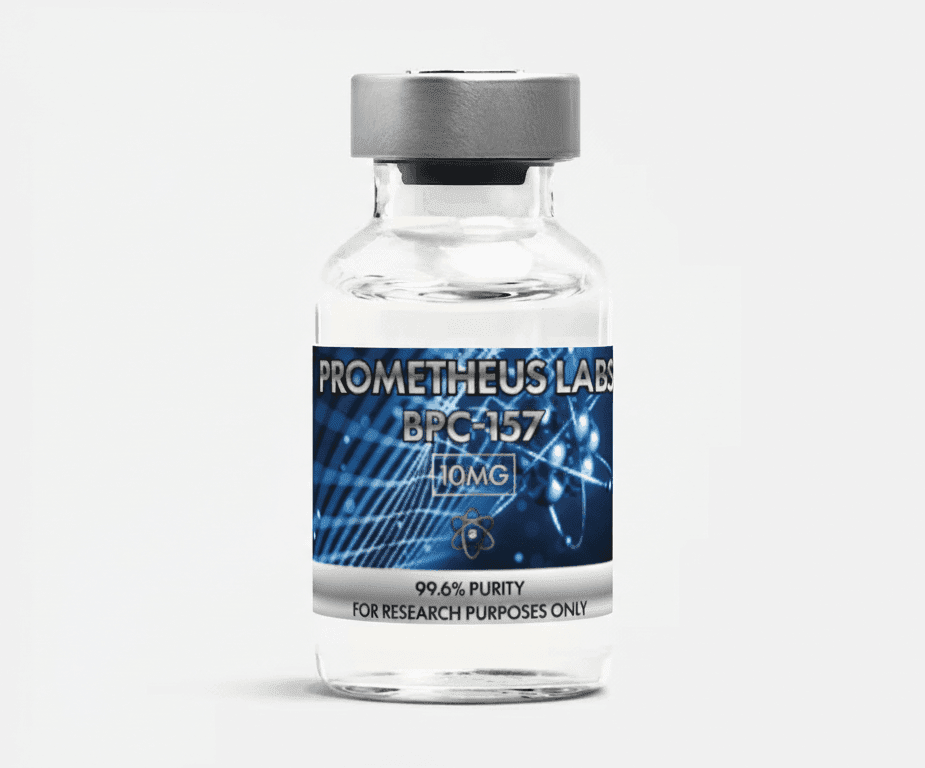
BPC-157 10mg is available at Performance Peptides Canada for qualified Canadian researchers. This batch has been HPLC-verified at 99%+ purity, with a Certificate of Analysis included with every order. BPC-157 (Body Protection Compound-157) is a synthetic pentadecapeptide derived from a gastric protein fragment, studied in non-clinical laboratory research for its cytoprotective signalling behaviour, tissue-level biological activity, and gastric stability. All products sold by Performance Peptides Canada are strictly for laboratory and research use only and are not intended for human consumption, medical use, or diagnostic applications.
BPC-157 (Body Protection Compound 157) is a synthetic pentadecapeptide derived from a protective protein natively found in human gastric juice. Known for its remarkable molecular stability, this 15-amino acid sequence is highly resistant to enzymatic degradation, making it a primary entity for investigating systemic and localized tissue repair.
Performance Peptides Canada provides BPC-157 at 99%+ purity, verified by batch-specific HPLC and Mass Spectrometry, ensuring the structural integrity required for precise laboratory research and domestic Canadian fulfillment.
For researchers requiring analytical accuracy, our BPC-157 is synthesized to meet the following biochemical benchmarks:
BPC-157 is studied for its pleiotropic effects, primarily through its interaction with the nitric oxide (NO) system and various growth factor receptors.
Experimental data suggests BPC-157 accelerates wound healing by activating the FAK-paxillin pathway. This process enhances the phosphorylation of focal adhesion kinase (FAK), promoting the migration and survival of fibroblasts at injury sites—a critical step in rebuilding the extracellular matrix.
BPC-157 has demonstrated the ability to promote angiogenesis (the formation of new blood vessels). It achieves this by increasing the expression of Vascular Endothelial Growth Factor Receptor 2 (VEGFR2), potentially bypassing occluded vessels to restore blood flow to ischemic tissues.
In tendon fibroblast research, BPC-157 has been shown to dose-dependently increase the expression of Growth Hormone Receptors (GHR). This upregulation may potentiate the anabolic effects of growth hormones, leading to enhanced collagen synthesis and biomechanical recovery in musculoskeletal models.
To maintain the integrity of the peptide during experimental use, the following laboratory protocols are recommended:
The shelf-life of BPC-157 is highly dependent on its physical state and environmental exposure.
| Storage Condition | State | Estimated Stability |
| -20°C to -80°C | Lyophilized (Dry) | 24+ Months |
| 2°C to 8°C (Fridge) | Lyophilized (Dry) | 12 Months |
| Room Temp (20°C) | Lyophilized (Dry) | 3 Months |
| 2°C to 8°C (Fridge) | Reconstituted | 7–14 Days |
Important: For long-term preservation, store vials in a dark, desiccated environment away from UV light. Avoid repeated freeze-thaw cycles, as this can denature the peptide chains.
Q: Is BPC-157 orally bioavailable?
A: Unlike many peptides, BPC-157 is uniquely stable in acidic environments and resistant to gastric juice for over 24 hours. In animal models, it remains bioavailable when administered orally, though injection remains the standard for localized injury research.
Q: What is the purity of your BPC-157?
A: We guarantee a minimum purity of 99%. Every batch undergoes rigorous third-party HPLC (High-Performance Liquid Chromatography) to confirm purity and MS (Mass Spectrometry) to verify molecular identity.
Q: Where does Performance Peptides Canada ship from?
A: All orders are fulfilled domestically from within Canada. This ensures your research is not interrupted by customs delays or international shipping stability risks.
Q: Is BPC-157 legal in Canada?
A: BPC-157 is not a controlled substance under the Controlled Drugs and Substances Act (Canada). However, Health Canada has issued warnings regarding unauthorized injectable peptide drugs sold for human use. Performance Peptides Canada supplies BPC-157 exclusively as a laboratory research reagent for non-clinical scientific research purposes. It is not approved by Health Canada for human therapeutic or injectable use, and is not sold for that purpose.
Q: What is BPC-157 used for in research?
A: BPC-157 (Body Protection Compound-157) is a synthetic pentadecapeptide derived from a protective protein found in gastric juice. It is studied in laboratory settings for its effects on angiogenesis, tendon and ligament repair mechanisms, nitric oxide synthesis, and gastrointestinal tissue modelling. Canadian researchers use it as a reference compound in connective tissue and wound healing studies.
Q: Has Health Canada issued warnings about BPC-157?
A: Health Canada has issued warnings regarding unauthorized injectable peptide drugs sold for human consumption through unregulated online vendors. Performance Peptides Canada operates as a legitimate laboratory research supplier. All products are supplied with HPLC-verified Certificates of Analysis, fulfilled domestically, and sold exclusively for non-clinical research use in compliance with Canadian regulations.
Q: What is the difference between injectable BPC-157 and research-grade BPC-157?
A: Health Canada’s warnings specifically target unauthorized injectable peptide drugs marketed for human therapeutic use without approval. Research-grade BPC-157, as supplied by Performance Peptides Canada, is a lyophilized laboratory reagent intended for controlled scientific study. It is not formulated, packaged, or sold as a therapeutic injectable product.
| Weight | 10mg |
|---|
Only logged in customers who have purchased this product may leave a review.


Reviews
There are no reviews yet.