- FREE Shipping with spend over $150
- We've moved! performancepeptidescanada.co same team, same products, same quality.
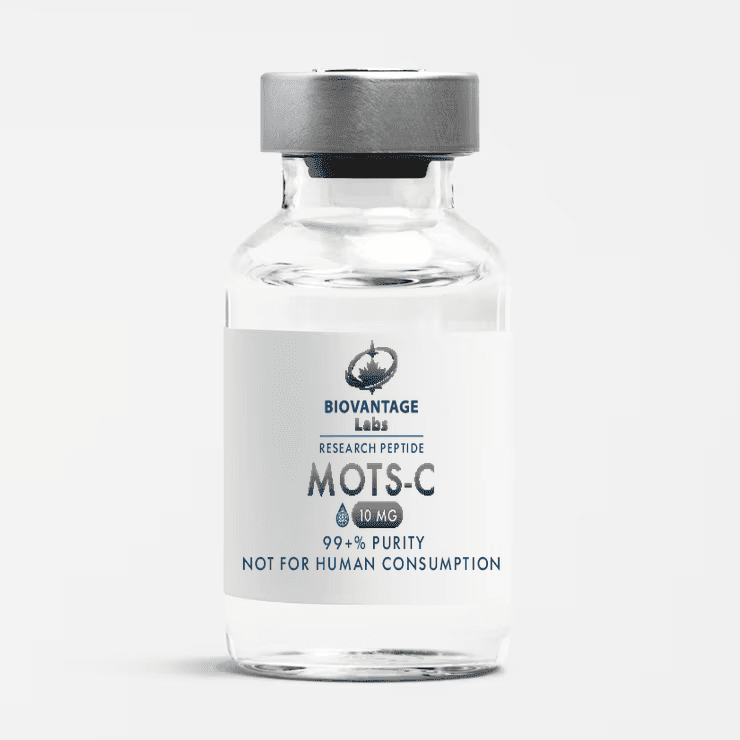
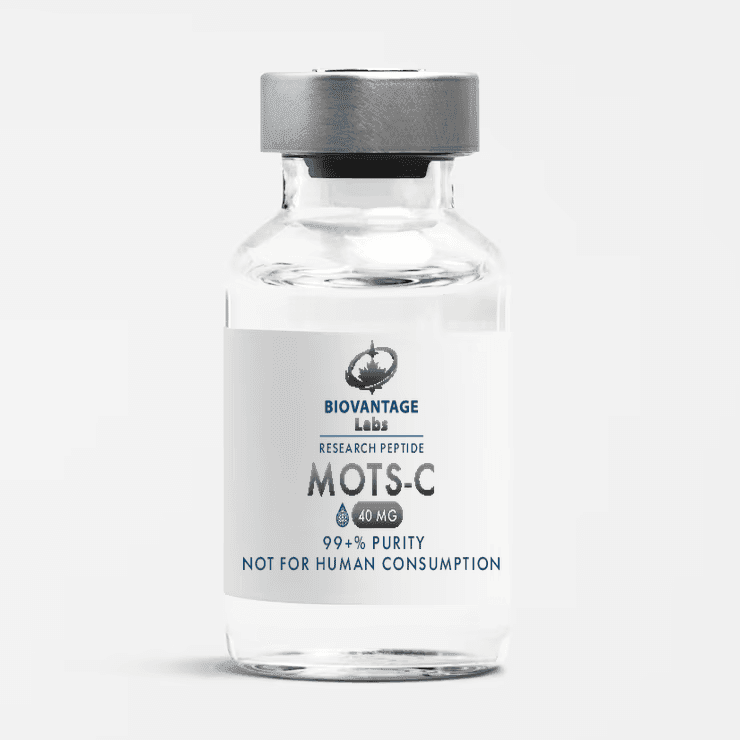
MOTS-c (Mitochondrial Open Reading Frame of the 12S rRNA-c) is a mitochondria-derived peptide studied for its role in metabolic regulation, AMPK pathway activation, and mitochondrial biogenesis signalling. Biovantage Labs supplies MOTS-c in 10mg and 40mg configurations at 99+% purity, verified by batch-specific HPLC and Mass Spectrometry. Domestically fulfilled from Canada. Not for human consumption.
$80.00 – $250.00Price range: $80.00 through $250.00
MOTS-c (Mitochondrial Open Reading Frame of the 12S rRNA-c) is a 16-amino acid mitochondria-derived peptide encoded within the mitochondrial genome a structurally distinct class from nuclear-encoded peptides. Its primary research significance lies in its role as a metabolic regulator, with particular focus on AMPK pathway activation, glucose homeostasis, and mitochondrial stress response signalling.
Biovantage Labs supplies MOTS-c in two research configurations 10mg and 40mg at 99+% purity, confirmed by batch-specific HPLC and Mass Spectrometry, for use in controlled laboratory settings.
| Specification | Detail |
| Molecular Formula | C110H174N36O33S |
| Molecular Weight | 2,174.8 Da |
| Origin | Mitochondrial 12S ribosomal RNA locus |
| Purity | ≥99+% (HPLC/MS verified) |
| Physical Form | Lyophilized white powder |
| Available Configurations | 10mg / 40mg |
MOTS-c is studied across metabolic, mitochondrial, and longevity research contexts. Its mitochondrial origin distinguishes its signalling properties from conventional nuclear-encoded peptides.
Mitochondrial longevity research examining both signalling and structural aspects of mitochondrial function may position MOTS-c alongside SS-31 (Elamipretide). MOTS-c studied for AMPK pathway activation and nuclear stress response signalling, SS-31 for cardiolipin stabilisation and electron transport chain structural integrity.
The most well-characterised research pathway for MOTS-c involves activation of AMP-activated protein kinase (AMPK), a central metabolic sensor. In skeletal muscle models, MOTS-c has been shown to stimulate AMPK phosphorylation, promoting glucose uptake independent of insulin a mechanism with significant implications for metabolic research.
Under conditions of mitochondrial stress, MOTS-c translocates from the mitochondria to the nucleus, where it modulates gene expression involved in cellular stress adaptation. This nucleus-directed activity positions MOTS-c as a subject of research in mitochondrial-nuclear communication and cellular resilience.
MOTS-c inhibits the folate cycle through accumulation of 5-aminoimidazole-4-carboxamide ribonucleotide (AICAR), an endogenous AMPK activator. This pathway is studied in the context of one-carbon metabolism and its downstream effects on nucleotide synthesis and methylation processes.
MOTS-c circulating levels decline with age in both animal and human subject studies. This pattern has positioned it as a candidate compound in longevity research models examining the relationship between mitochondrial signalling and biological ageing processes.
MOTS-c’s AMPK activation research intersects with NAD+ biology at the cellular energy-sensing level. AMPK and sirtuin pathways are both regulated by cellular energy status, and research examining MOTS-c’s metabolic effects is often designed alongside NAD+ availability studies to characterise the relationship between mitochondrial signalling and coenzyme pool dynamics.
| Configuration | Typical Research Application |
| 10mg | Pilot studies, dose-response investigations, shorter experimental timelines |
| 40mg | Extended protocols, multi-cohort studies, higher-throughput laboratory settings |
| Storage Condition | State | Estimated Stability |
| -20°C to -80°C | Lyophilized | 24+ months |
| 2°C to 8°C | Lyophilized | 12 months |
| Room temperature (20°C) | Lyophilized | 3 months |
| 2°C to 8°C | Reconstituted | 7 to 14 days |
Store in a desiccated environment away from UV exposure. Avoid repeated freeze-thaw cycles.
Q: What distinguishes MOTS-c from other mitochondria-derived peptides?
A: MOTS-c is encoded within the mitochondrial genome rather than nuclear DNA, placing it in a distinct class of peptides. Its capacity for nuclear translocation under stress conditions makes it a subject of interest in research examining mitochondrial-nuclear signalling as a discrete regulatory axis.
Q: Why does Biovantage Labs offer MOTS-c in two configurations?
A: The 10mg configuration supports pilot studies and dose-response work where compound conservation matters. The 40mg configuration serves extended research protocols and multi-cohort designs. Both are produced to the same 99+% purity standard.
Q: What purity standard does Biovantage Labs apply to MOTS-c?
A: Every batch is verified at 99+% purity using HPLC to confirm compound concentration and Mass Spectrometry to confirm molecular identity. Batch-specific COA documentation is available upon request.
Q: Is MOTS-c for human use?
A: No. MOTS-c supplied by Biovantage Labs is strictly for laboratory research purposes. It is not approved for human consumption, veterinary use, or clinical application.
| mg | 10, 40 |
|---|
Only logged in customers who have purchased this product may leave a review.


Explore premium-grade peptides for scientific research, purity tested, lab certified, and shipped discreetly.

Automated page speed optimizations for fast site performance

Reviews
There are no reviews yet.