
$80.00
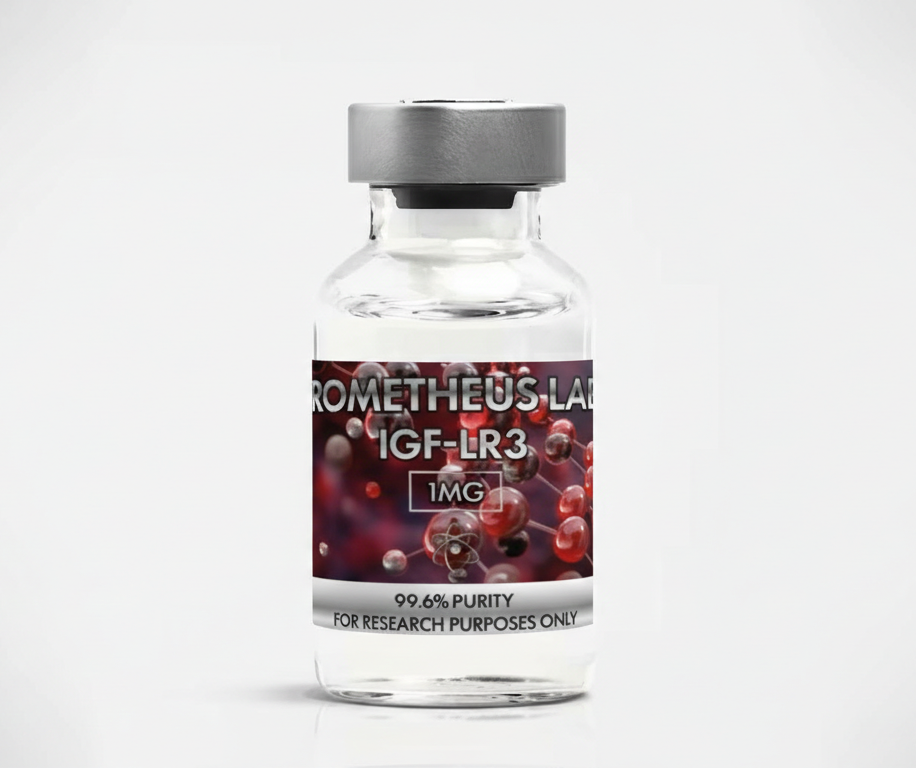
IGF-1 LR3 (Long R3 Insulin-like Growth Factor-I) is a synthetic, 83-amino acid analogue of human IGF-1. It is modified by the substitution of an Arginine (Arg) for Glutamic Acid (Glu) at position 3 (hence “R3”) and the addition of a 13-amino acid extension peptide at the N-terminus. These modifications result in a peptide that is significantly more potent than native IGF-1 because it possesses a greatly reduced affinity for IGF-Binding Proteins (IGFBPs).
Prometheus Labs offers IGF-1 LR3 1mg vials at 99%+ HPLC-verified purity. Our domestic Canadian fulfillment ensures that this highly potent growth factor is handled with strict temperature controls to preserve its biological activity for musculoskeletal and cellular proliferation research.
Our IGF-1 LR3 is synthesized to meet the following analytical benchmarks:
IGF-1 LR3 is a cornerstone of research into muscle cell development and metabolic signaling.
The primary limitation of natural IGF-1 is its short half-life (approx. 10–20 minutes) due to rapid sequestration by IGF-Binding Proteins. The LR3 modification prevents this binding, allowing the peptide to remain active in the system for 20–30 hours. Researchers utilize this extended window to study continuous stimulation of the IGF-1 Receptor (IGF-1R).
In skeletal muscle research, IGF-1 LR3 is investigated for its ability to induce hyperplasia, the splitting and formation of new muscle fibers, rather than just hypertrophy (size increase). It activates the PI3K/Akt/mTOR pathway, which is essential for studying satellite cell activation and DNA-to-protein translation.
As an “insulin-like” factor, IGF-1 LR3 is studied for its ability to mimic insulin’s effect on glucose transport into cells. Researchers use it to examine non-insulin-dependent glucose uptake in peripheral tissues, making it a vital entity for studying glucose disposal and metabolic efficiency.
IGF-1 LR3 is an extremely sensitive large-chain peptide. Improper reconstitution can easily result in denatured protein.
| Storage Condition | Physical State | Estimated Stability |
| -20°C (Freezer) | Lyophilized (Dry) | 24 Months |
| 2°C to 8°C (Fridge) | Lyophilized (Dry) | 12 Months |
| 2°C to 8°C (Fridge) | Reconstituted | 5–7 Days |
Note: Due to its sensitivity, IGF-1 LR3 should be used as soon as possible after reconstitution for the most accurate research results.
Q: Is IGF-1 LR3 legal in Canada?
A: IGF-1 LR3 is not a controlled substance under the Controlled Drugs and Substances Act (Canada). It is legally available for legitimate scientific research purposes. Prometheus Labs supplies IGF-1 LR3 exclusively for laboratory research use. It is not approved by Health Canada for human or veterinary therapeutic use.
Q: What is the difference between IGF-1 and IGF-1 LR3?
A: Endogenous IGF-1 has a biological half-life of approximately 10-20 minutes due to rapid binding by IGF-binding proteins (IGFBPs). IGF-1 LR3 (Long R3 IGF-1) is a synthetic analogue with a modified amino acid sequence that significantly reduces IGFBP affinity, extending the active half-life to approximately 20-30 hours. This makes IGF-1 LR3 substantially more effective for sustained somatotropic and anabolic signalling research than native IGF-1.
Q: What is IGF-1 LR3 used for in research?
A: IGF-1 LR3 is a primary research tool for studying insulin-like growth factor signalling pathways, including skeletal muscle hypertrophy, satellite cell activation, nitrogen retention, and adipose tissue metabolism. Canadian researchers use it to model anabolic and anti-catabolic mechanisms in controlled in vitro and in vivo settings.
Q: What does IGF-1 LR3 stand for?
A: IGF-1 LR3 stands for Insulin-Like Growth Factor-1 Long Arg3. The “Long R3” designation refers to the 13 additional amino acids at the N-terminus and the substitution of glutamic acid with arginine at position 3, the two structural modifications that reduce IGFBP binding affinity and extend biological activity.
Q: Why is IGF-1 LR3 considered superior to IGF-1 DES?
A: It is not necessarily “superior,” but it serves a different purpose. DES is shorter-acting and studied for localized effects, whereas LR3 is long-acting and studied for systemic effects due to its inability to be neutralized by binding proteins.
Q: What is the purity of your IGF-1 LR3?
A: We guarantee a purity of 99% or higher. Each 1mg vial is verified via High-Performance Liquid Chromatography (HPLC) to ensure it meets our strict quality standards for Canadian research.
Q: Is this product shipped domestically in Canada?
A: Yes. Performance Peptides Canada fulfills all orders from our domestic facilities. This is critical for IGF-1 LR3, as it is highly sensitive to temperature fluctuations and the mechanical stress of international shipping.
Only logged in customers who have purchased this product may leave a review.



Explore premium-grade peptides for scientific research, purity tested, lab certified, and shipped discreetly.

Reviews
There are no reviews yet.