
Have a question about a compound, reconstitution protocol, or COA? Our analytical team responds within one business day.




This guide covers what research peptides are, whether buying them in Canada is legal, how to check that you are getting what you paid for, what can go wrong when you order from another country, and which products Canadian suppliers carry. These compounds are for lab research only, not for use in people.
Your body sends tiny messages between its cells all day long. These messages tell your body when to heal a cut, when to fight an infection, and when to release certain hormones. Each message is carried by a small protein called a peptide. Scientists want to understand exactly how these messages work. To study them, researchers make copies of these small proteins in a laboratory. These lab-made copies are called research peptides.
Research peptides are not medicines. Health Canada has not approved any of them for use in people. Companies sell them as materials for scientific experiments, the same way a lab might buy chemicals or tools to run a test.
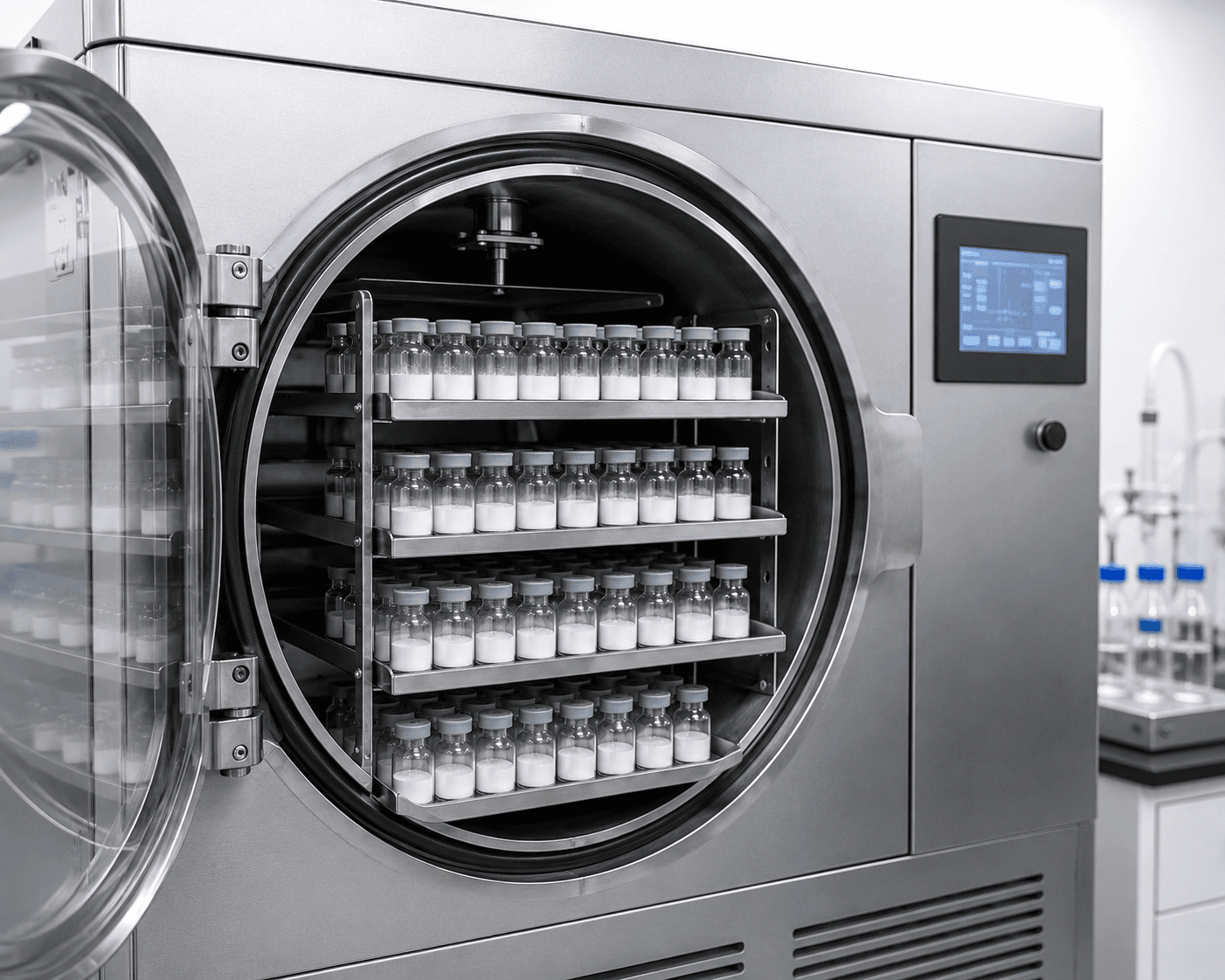
When you order a research peptide, it arrives as a white powder inside a small sealed glass bottle. Before the company packed it, they removed all the water from it. This keeps the powder from breaking down while it travels to you. When a researcher is ready to use it in an experiment, they add a liquid to dissolve the powder.
Research peptides Canada suppliers carry most often includes:
A small protein that comes from the lining of the stomach. Scientists use it in animal studies to look at how the body grows new blood vessels and how it sends healing signals to damaged tissue.
A lab-made copy of a small piece of a natural protein your body uses to help cells keep their shape and move around. Scientists study it to understand how cells travel through tissue when the body is trying to repair itself. Health Canada mentioned this compound in its public warnings about health claims.
Based on a natural growth signal, the body produces when the brain tells it to grow. The lab version stays active in a cell sample for longer than the natural version does. Scientists use it to study how growth messages affect cells and what those messages cause cells to do.
Sends a message to a small gland at the base of the brain, telling it to release a growth hormone. Animal studies show it can do this without raising the level of the body’s stress hormone at the same time. Health Canada mentioned this compound in its public warnings.
Copies a signal the brain sends when it wants the body to release growth hormone. The lab version stays active in the body longer than the natural signal does. Scientists often test it alongside Ipamorelin because the two signals act at two different points in the same chain of events.
A tiny three-part piece taken from a natural hormone that helps the body control swelling. Scientists test it in cell samples taken from the gut to study how the body reacts when that area becomes inflamed.
Comes from one end of the growth hormone molecule. In studies using fat tissue cells, scientists look at whether it changes how fat cells release stored fat into the blood. In those studies, it did not appear to affect blood sugar the way the full growth hormone molecule does.
A small protein that a gland in your chest, called the thymus, makes on its own. That gland helps prepare your body’s infection-fighting cells for their job. Scientists study this protein to understand how it affects the development and performance of those cells. Studies on it go back to the 1970s, making it one of the most researched compounds in this group.
Before you trust any supplier, you need to answer two questions about the product:
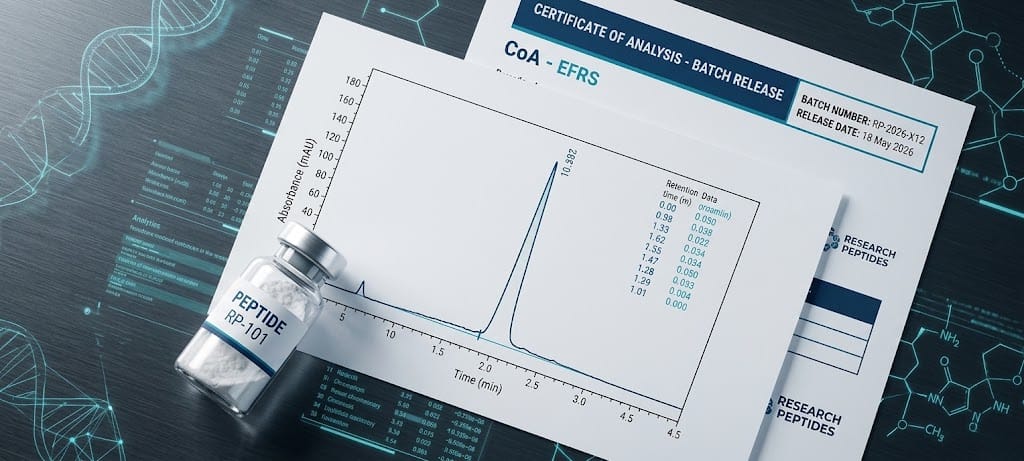
A document called a quality test report answers both. An independent laboratory, one with no connection to the seller, writes this report after testing a specific batch of the product.
The report covers two separate tests. The first test checks how pure the product is. It measures what share of the powder is the compound you actually ordered. If the result says 99%, that means 1% of the powder is something else.
The second test checks the identity of the compound. It confirms that the powder in the bottle really is the compound named on the label, not something that just looks similar. You need both results. One without the other still leaves a question unanswered.
A trustworthy quality report includes:
The batch number is what connects the report to your specific order. A supplier who uses the same report for every customer only proves that one old batch passed the test, not the batch they are sending you today.
If you want to buy peptides online in Canada, the supplier you choose makes all the difference. Performance Peptides Canada is the best peptide supplier in Canada for researchers who want verified quality and domestic shipping. An independent lab tests every batch and confirms the purity is 99% or higher. The test report for the current batch is on every product page. Every order ships from within Canada.
Removing the water from a compound and turning it into a dry powder makes it much more stable. Powder holds up better when it gets warm than a liquid does. This matters because your package might sit in a warm place for hours or days during shipping. Once a researcher is ready to use the compound in an experiment, they add water or another liquid to dissolve the powder. After that, the compound starts to break down more quickly, so researchers mix only the amount they need for each experiment rather than making a large batch.
Yes. At Performance Peptides Canada, every product page has the current batch test report available as a free download. It shows the batch number, the purity result, the identity result, the name of the testing lab, and the date the tests were done. You do not need to create an account or make a purchase first.
Yes, sometimes. A scientist might test two compounds at the same time if each one works at a different step in the same process. Testing them together shows whether the result changes when both are present. Some lab experiments use both to see how those steps interact.
When your order ships, open the tracking link. The first location shown in the tracking history tells you where the package started. If that starting point is inside Canada, the company sent it from Canada. If the first Canadian location shows up after the package has already moved through several places in another country, it was sent from outside Canada and crossed the border on the way to you. You can also ask the company directly for the street address of the warehouse they ship from. The first scan in the tracking history is still the most reliable way to confirm.
Research peptides do not appear on Canada’s official list of banned substances. They are also not approved medicines. This puts them in the middle; a company can sell them, but only if it does not claim that the product treats, cures, or helps any health problem.
| For Research Use Only: Every compound mentioned in this article is sold for use in lab research only. Health Canada has not approved any of them for use in people. Nothing in this article is medical advice. Do not use it to make any health decision. Performance Peptides Canada | performancepeptidescanada.ca | All products supplied under the Biovantage Labs brand. |
Experience unparalleled research integrity with 99%+ purity guaranteed via third-party HPLC testing, supported by 100% domestic Canadian fulfillment and expert technical guidance for every reconstitution and storage inquiry.
One Response