
Have a question about a compound, reconstitution protocol, or COA? Our analytical team responds within one business day.


When you order research peptides from outside Canada, three things can go wrong: the package gets seized at the border, the compounds inside arrive damaged from heat, or your research timeline gets pushed back by weeks. This guide explains exactly why the peptide shipping Canada researchers trust most comes from domestic suppliers, and what to look for when verifying a source.
Every international shipment that enters Canada goes through the Canada Border Services Agency, the CBSA. Officers check whether the contents comply with Canadian health laws. If a package looks suspicious or the compounds inside are on Health Canada’s radar, the CBSA holds the shipment and contacts Health Canada to determine what happens next.
Under the CBSA’s health product importation rules, if a shipment fails the review, it gets refused entry or seized. You will not get the compounds back, and you will not get a refund. The order is simply gone.
In April 2026, Health Canada issued a public advisory naming BPC-157, TB-500, CJC-1295, Ipamorelin, and related compounds as active seizure targets at the border. If your international order contains any of these, it faces a real and documented risk. Canada customs peptides seizures like these are not rare exceptions; they are an expected outcome for researchers who rely on international sources for these specific compounds.
Sourcing domestic peptides in Canada removes this risk entirely. When a supplier ships from within Canada, the package never enters a border checkpoint. There is nothing to seize.
Customs risk is easy to see coming. Compound damage in transit is invisible, and it can quietly ruin your research results without any obvious sign.
Research peptides are delicate molecules. They break down when exposed to heat, moisture, and light. Even freeze-dried peptides, the most stable storage format, can degrade during a long international journey. When that happens, the vial looks completely normal. But the purity inside no longer matches what the testing certificate says.
Here is where international shipping breaks that chain:
A brief two-hour heat exposure causes limited damage. A package sitting at customs for a week is a very different story. By the time that vial reaches you, the compound’s purity may have dropped, and you have no way to know by how much.
Many suppliers advertise Canadian shipping. That does not mean they are based in Canada.
Some suppliers process orders from a US warehouse and route packages through a Canadian forwarding address. The label looks domestic. But the compound still crossed the border with all the same customs and cold-chain risk that comes with it.
True domestic fulfillment means the compound is stored in Canada, prepared in Canada, and handed to a Canadian courier without ever leaving the country. That is the only version that removes the problem.
Researchers sourcing BPC-157 or TB-500 should ask one direct question before ordering: Does this ship from Canada, or just to Canada? The answer changes everything.
You do not have to take a supplier’s word for it. Choosing a verified domestic peptide supplier Canada researchers can trust comes down to four checks you can do before placing an order.
When your order ships, the first scan on Canada Post, Purolator, or FedEx tracking shows the city it left from. If a ‘Canadian’ supplier’s shipments consistently originate from a US city, that tells you everything you need to know.
A real Canadian supplier has a Canadian Business Number (BN) issued by the Canada Revenue Agency, plus a GST/HST registration. A legitimate operation shares this without hesitation.
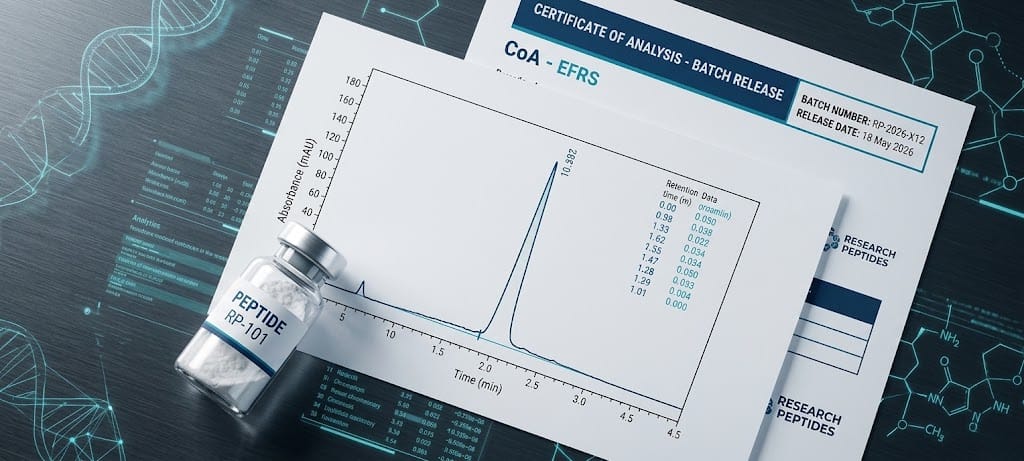
A Certificate of Analysis or COA is the document that proves a compound’s purity. Generic COAs with no batch number and no named laboratory are a red flag. Real domestic suppliers test each batch at a Canadian third-party lab and publish a COA tied to that specific batch — not a single document recycled across all products.
Email or message the supplier: Where is this compound stored, and which facility dispatches orders? A supplier with genuine domestic infrastructure answers this clearly. A forwarding-address operation cannot.
Where you source your research peptides is a research decision, not just a logistics one. International suppliers bring customs risk, cold-chain gaps, and unpredictable delivery timelines that can derail an entire protocol. Domestic peptide shipping from a verified Canadian supplier removes every one of those variables.
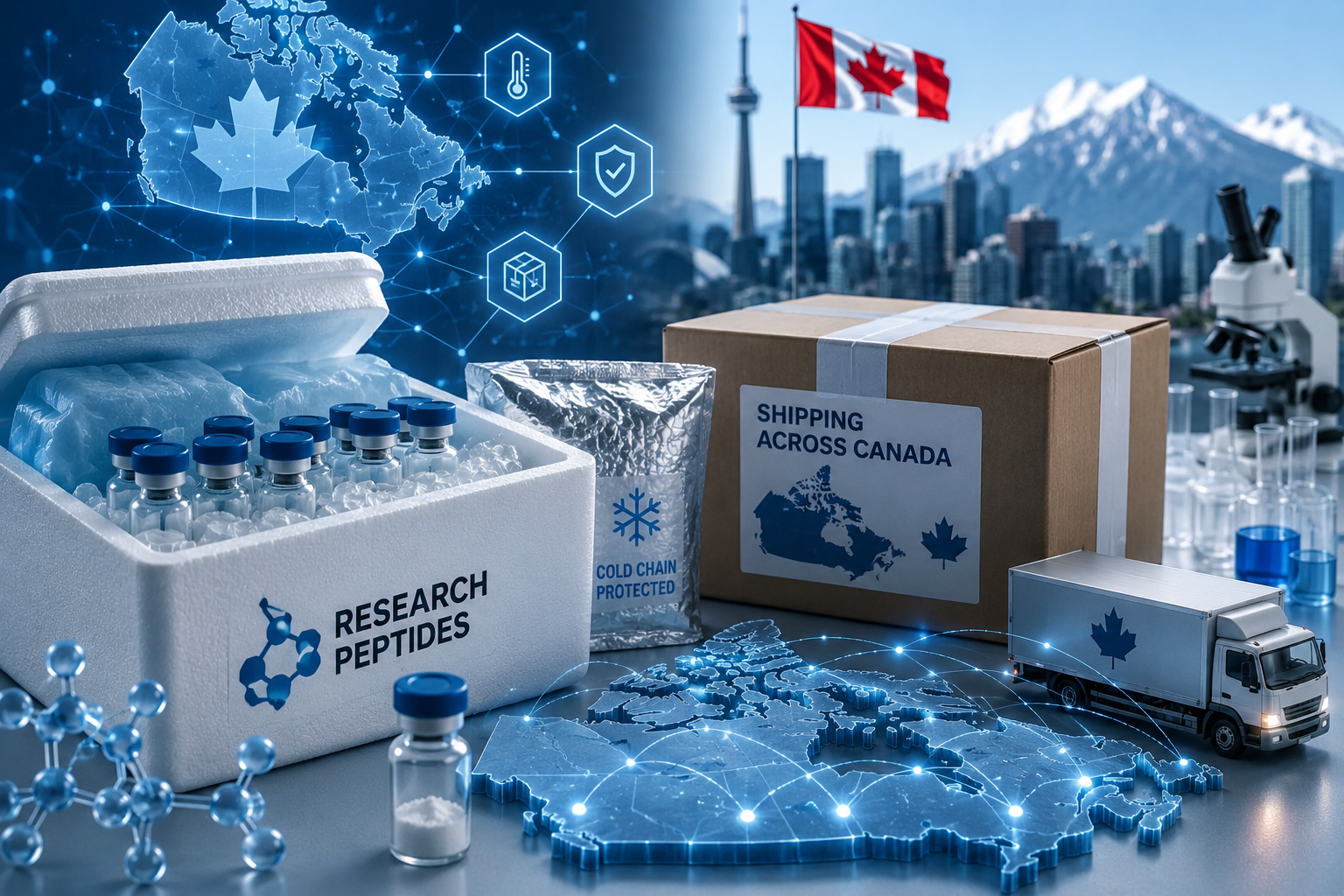
The compound leaves a climate-controlled Canadian facility. It travels through the domestic courier network without a single border checkpoint. It arrives with a batch-specific COA you can verify before it even ships.
Performance Peptides Canada ships every order from within Canada, with HPLC and mass spectrometry testing verified per batch. Browse the full range and download COA documents at performancepeptidescanada.ca.
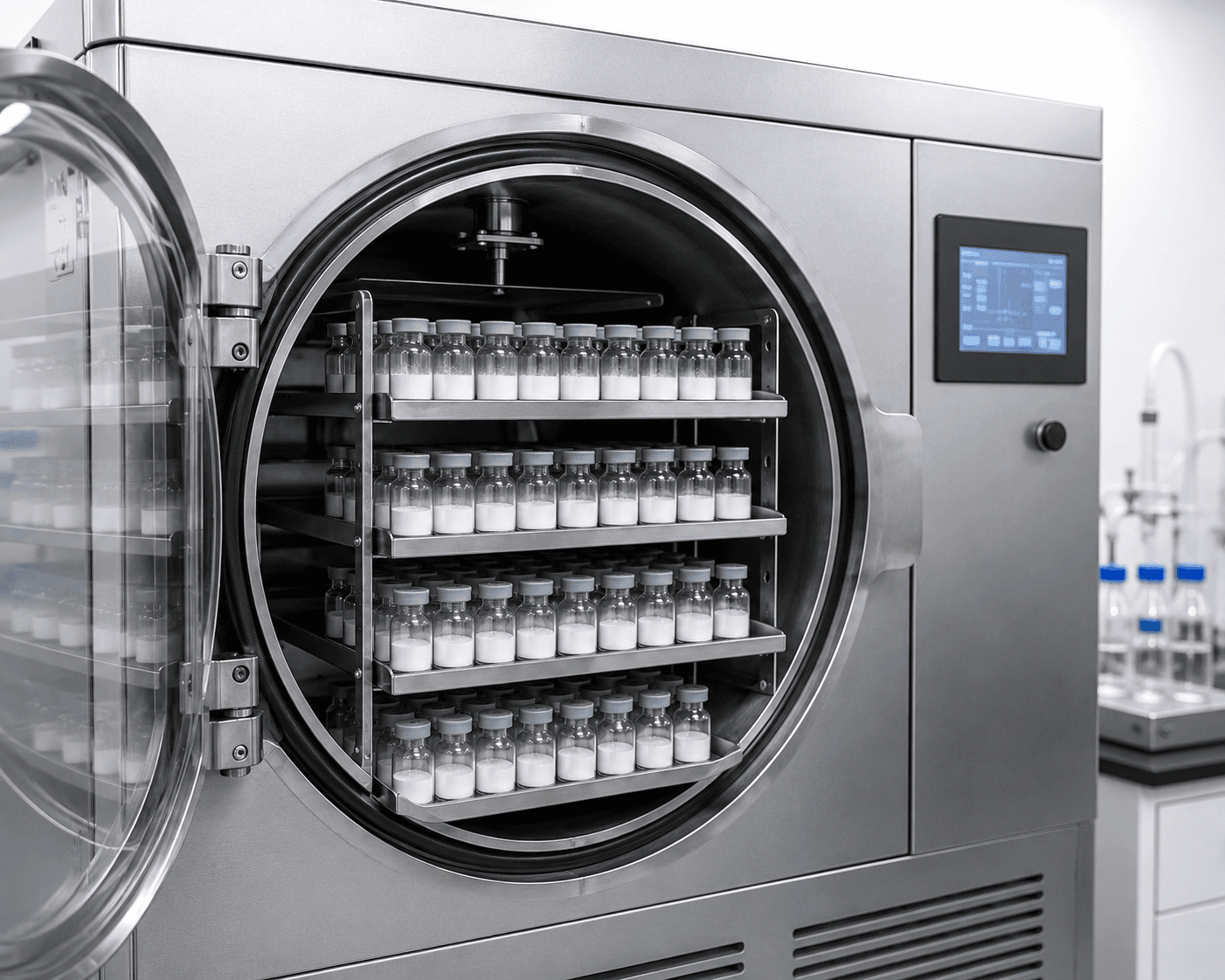
Freeze-drying removes almost all of the water from a peptide compound and turns it into a dry, stable powder sealed inside a vial. This format holds up much better to temperature changes than a liquid form. That said, freeze-dried peptides are not indestructible; extended heat or a broken vial seal can still cause the compound to break down. Freeze-drying makes safe shipping possible, but it does not eliminate the need for careful handling throughout the journey.
Most domestic orders from Canadian suppliers arrive within two to five business days, coast to coast. That covers Vancouver to Halifax without issue. International orders, when they clear without a hold, typically take ten to twenty-one days. If a package gets flagged for inspection, that timeline extends unpredictably, and there is no guarantee it gets released.
Research peptides are sold for in-vitro laboratory and independent research use only. In that context, Canadian researchers can source from compliant domestic suppliers without a personal prescription. That said, Canada regulates these compounds under the Food and Drugs Act, and their distribution for human use is restricted. Always confirm the research-use terms with your supplier and consult Health Canada’s guidance if you have questions about your specific research situation.
A general COA covers an entire product line and may have been created months or years ago. A batch-specific COA is tied to the exact lot of compound that goes into your order. It shows the purity, the testing method (HPLC and mass spectrometry are the standard), and the date the test was run. If a supplier cannot match your order to a specific batch and a specific COA, you have no real way to verify what you are receiving.
Unfortunately, seized shipments are rarely returned. Health Canada and the CBSA do not typically release compounds that fail their inspection process, and most international suppliers do not offer refunds for seized orders. Your best option is to source from a domestic Canadian supplier for all future orders, one that stores and ships from within Canada, so the issue does not repeat.
| Research Use Only: All products referenced in this article are sold strictly for in-vitro laboratory and independent research use only. They are not approved for human use and are not intended to diagnose, treat, cure, or prevent any condition. Performance Peptides Canada operates in compliance with Health Canada guidelines. For regulatory questions, see Health Canada’s importation guidance or consult a qualified legal professional. |
Experience unparalleled research integrity with 99%+ purity guaranteed via third-party HPLC testing, supported by 100% domestic Canadian fulfillment and expert technical guidance for every reconstitution and storage inquiry.