
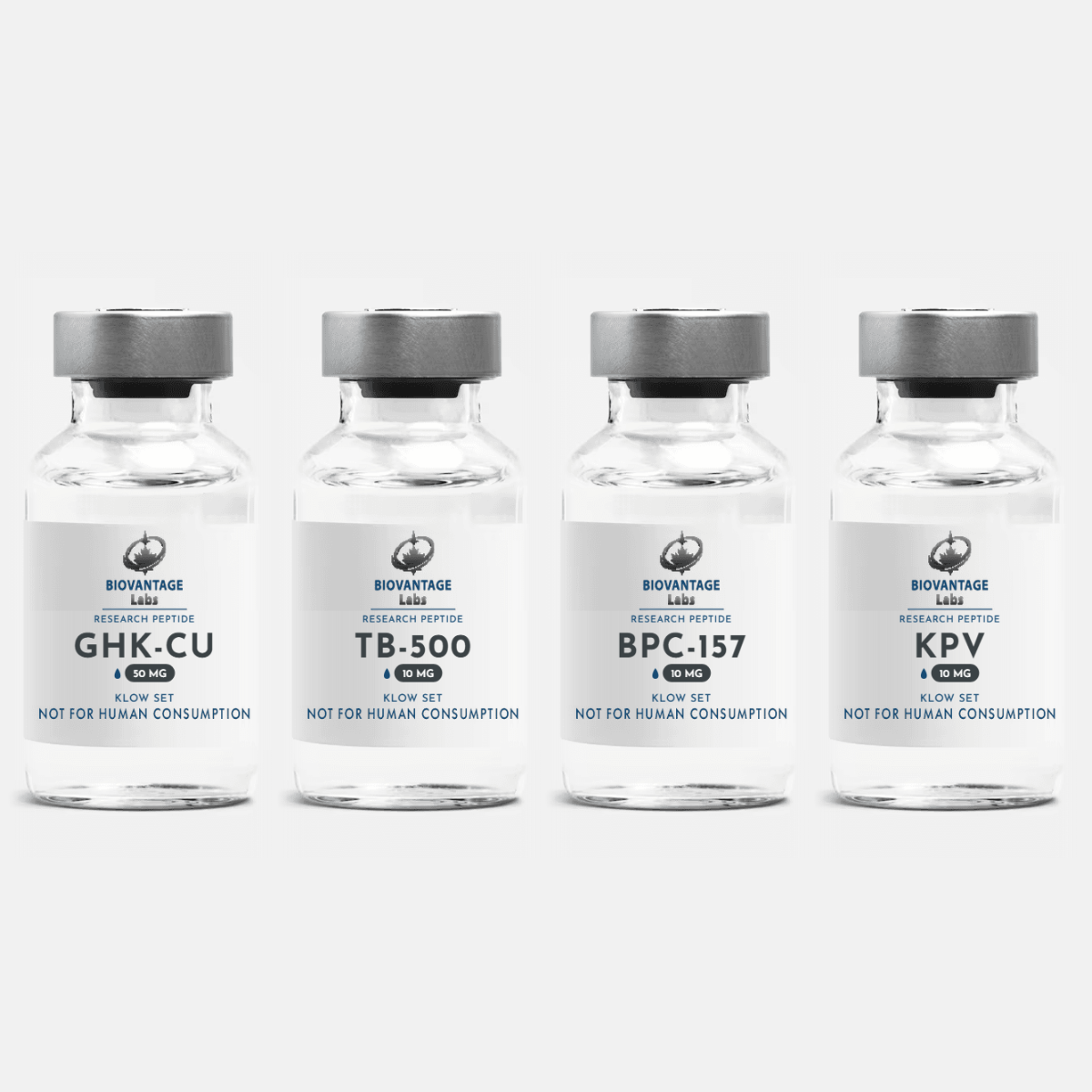
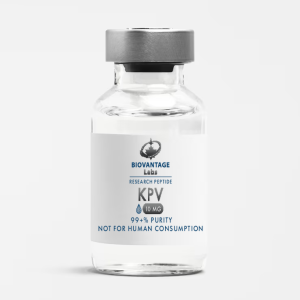
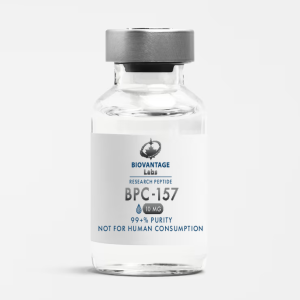
The KLOW Blend is a Biovantage Labs research set of four compounds in separate lyophilized vials: GHK-Cu 50mg, TB-500 10mg, BPC-157 10mg and KPV 10mg. It adds KPV to the GLOW compounds, and separate vials let each peptide be tested as its own variable. Domestically fulfilled from Canada. For in vitro laboratory research use only. Not for human or animal consumption.
$130.00
The KLOW Blend is a Biovantage Labs research set of four peptides supplied in separate lyophilized vials: GHK-Cu 50mg, TB-500 10mg, BPC-157 10mg and KPV 10mg. It contains the three GLOW compounds plus KPV, the C-terminal tripeptide of alpha-MSH. This page covers what is in each vial, how the four compounds compare by molecule count, and how to reconstitute and store each one.
| Vial | Amount | Sequence | Molecular formula | Molecular weight |
|---|---|---|---|---|
| GHK-Cu | 50mg | Gly-His-Lys : Cu(II) | C14H22CuN6O4 | 401.9 g/mol |
| TB-500 | 10mg | Ac-Leu-Lys-Lys-Thr-Glu-Thr-Gln | C38H68N10O14 | 889.0 g/mol |
| BPC-157 | 10mg | Gly-Glu-Pro-Pro-Pro-Gly-Lys-Pro-Ala-Asp-Asp-Ala-Gly-Leu-Val | C62H98N16O22 | 1419.5 g/mol |
| KPV | 10mg | Lys-Pro-Val | C16H30N4O4 | 342.4 g/mol |
Separate vials let researchers treat each compound as an independent variable: test each one alone or in any combination, set their own ratio, and reconstitute only the vial being used while the others stay lyophilized and frozen. This matters more with four compounds, because a single pre-mixed vial would leave no way to separate KPV’s contribution from the other three.
The set amounts are by mass. Because GHK-Cu and KPV are both small molecules, together they account for nearly 90% of the molecules in the full set, even though BPC-157, TB-500 and KPV are each supplied at 10mg:
| Vial | Mass | Amount | Share of molecules in the full set |
|---|---|---|---|
| GHK-Cu | 50mg | 124.4 µmol | 72.4% |
| KPV | 10mg | 29.2 µmol | 17.0% |
| TB-500 | 10mg | 11.25 µmol | 6.5% |
| BPC-157 | 10mg | 7.04 µmol | 4.1% |
At equal mass, the KPV vial holds about four times as many molecules as the BPC-157 vial. Match single-compound controls by molarity, not by mg/mL.
GHK-Cu is the copper(II) complex of the tripeptide glycyl-L-histidyl-L-lysine, first identified in human plasma. Research has focused on its copper-binding chemistry and on gene-expression data showing GHK can influence the expression of a large number of human genes in cell studies (Pickart and Margolina, 2018).
TB-500 is a synthetic acetylated peptide (Ac-LKKTETQ) corresponding to the central actin-binding region of thymosin beta-4, a 43-amino-acid protein that sequesters G-actin. It is studied in actin dynamics and cell motility research (Goldstein et al., 2012).
BPC-157 is a synthetic 15-amino-acid peptide based on a partial sequence of a protein identified in gastric juice. Preclinical research has examined its relationship with angiogenic signalling, including vascular endothelial growth factor (VEGF) pathways (Seiwerth et al., 2018).
KPV is the tripeptide lysine-proline-valine, corresponding to residues 11 to 13 at the C-terminus of alpha-melanocyte-stimulating hormone (alpha-MSH). In intestinal epithelial cell models it is transported by the peptide transporter PepT1, and research has examined its effect on NF-kappaB and MAPK inflammatory signalling (Dalmasso et al., 2008).
Reconstitute each vial separately with bacteriostatic or sterile water for laboratory use, adding the water slowly down the vial wall and swirling gently rather than shaking. Because the compounds differ in molecular weight, equal mg/mL stocks have very different molar concentrations:
| Vial | Water added | Concentration | Molarity |
|---|---|---|---|
| GHK-Cu 50mg | 2.5 mL | 20 mg/mL | 49.8 mM |
| GHK-Cu 50mg | 5 mL | 10 mg/mL | 24.9 mM |
| TB-500 10mg | 1 mL | 10 mg/mL | 11.25 mM |
| TB-500 10mg | 2 mL | 5 mg/mL | 5.62 mM |
| BPC-157 10mg | 1 mL | 10 mg/mL | 7.04 mM |
| BPC-157 10mg | 2 mL | 5 mg/mL | 3.52 mM |
| KPV 10mg | 1 mL | 10 mg/mL | 29.2 mM |
| KPV 10mg | 2 mL | 5 mg/mL | 14.6 mM |
Colour check: GHK-Cu is a copper complex, so its powder and solution are blue. A colourless GHK-Cu solution indicates the copper complex is absent. The other stocks should be clear and colourless.
Store every vial lyophilized, sealed, frozen and protected from light until use. Because the compounds are in separate vials, only the one being used needs to be reconstituted. Allow each vial to reach room temperature before opening to limit moisture uptake. Once reconstituted, refrigerate each stock and avoid repeated freeze-thaw cycles by freezing single-use aliquots. For full handling guidance, see the peptide reconstitution and storage guide.
KLOW contains the same GHK-Cu 50mg, TB-500 10mg and BPC-157 10mg vials as the GLOW Blend, plus a fourth vial of KPV 10mg. Because KPV is supplied separately, a KLOW protocol can be run with or without it, which makes GLOW and KLOW results directly comparable.
No. The KLOW Blend is four separate vials: GHK-Cu 50mg, TB-500 10mg, BPC-157 10mg and KPV 10mg.
KPV is the tripeptide Lys-Pro-Val, the C-terminal residues 11 to 13 of alpha-MSH, with a molecular weight of 342.4 g/mol.
GHK-Cu is a complex of the GHK tripeptide with copper(II), which gives the powder and its solution a blue colour.
Yes. Every order is fulfilled domestically by Performance Peptides Canada, with no cross-border customs clearance.
No. All compounds in the set are sold strictly for in vitro laboratory research. They are not drugs, natural health products or cosmetics, and are not for human or animal consumption.
| Contents | 4 vials: GHK-Cu 50mg, TB-500 10mg, BPC-157 10mg, KPV 10mg |
|---|
Only logged in customers who have purchased this product may leave a review.
Explore premium-grade peptides for scientific research, purity tested, lab certified, and shipped discreetly.
Storewide SALE. Offer ends December 1st.
Enter the code at checkout. For laboratory research use only. Not for human or animal consumption.
Reviews
There are no reviews yet.