
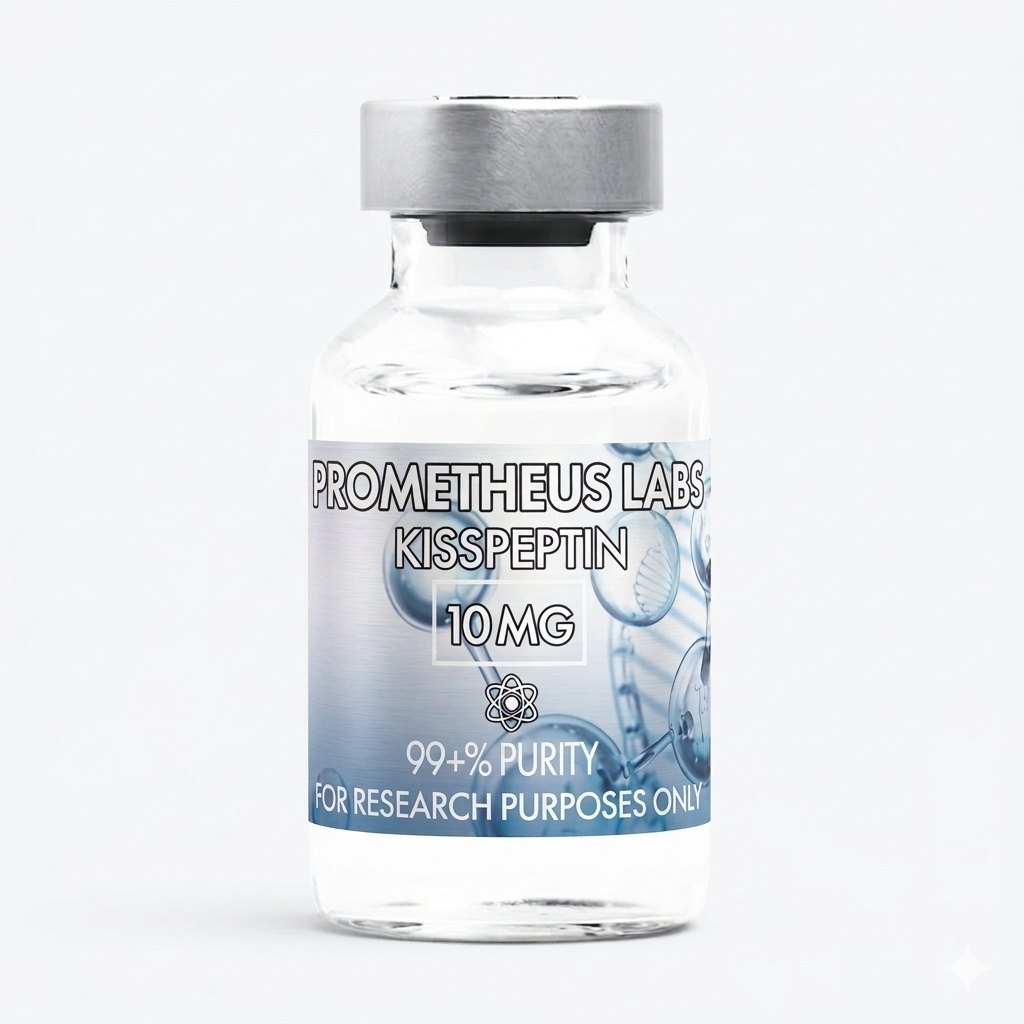
Kisspeptin-10 is the biologically active C-terminal decapeptide fragment of the KISS1 gene product, studied for its role as the primary endogenous activator of GnRH neuron signalling in hypothalamic-pituitary-gonadal axis research models. Prometheus Labs supplies Kisspeptin-10 at 99+% purity, verified by batch-specific HPLC and Mass Spectrometry, as a lyophilized research compound for laboratory use. Domestically fulfilled from Canada. Not for human consumption.
$70.00
Kisspeptin-10 is the C-terminal decapeptide fragment (residues 45-54) of the KISS1 gene-derived peptide family, representing the minimal sequence required for full kisspeptin receptor (KISS1R / GPR54) activation. It is the most widely studied form in reproductive neuroendocrinology research due to its defined pharmacophore, well-characterised receptor binding profile, and suitability for controlled experimental dosing in both in vitro and in vivo models.
Prometheus Labs provides Kisspeptin-10 at 99+% purity, confirmed by batch-specific HPLC and Mass Spectrometry analysis, as a lyophilized compound for use in controlled laboratory settings.
Note for researchers: The Kisspeptin family includes several forms derived from the same KISS1 precursor, Kisspeptin-54, Kisspeptin-14, Kisspeptin-13, and Kisspeptin-10. All share the same C-terminal decapeptide pharmacophore and activate KISS1R with comparable affinity. Kisspeptin-10 is the standard research form for mechanistic and receptor-level investigation.
| Specification | Detail |
|---|---|
| Molecular Formula | C63H83N15O12 |
| Molecular Weight | 1,302.4 Da |
| Sequence | Tyr-Asn-Trp-Asn-Ser-Phe-Gly-Leu-Arg-Phe-NH2 |
| Receptor Target | KISS1R (GPR54) |
| Purity | ≥99+% (HPLC/MS verified) |
| Physical Form | Lyophilized white powder |
| CAS Number | 374677-98-2 |
Kisspeptin-10 is investigated across reproductive neuroendocrinology, metabolic regulation, and oncology research contexts. Its primary characterisation centres on HPG axis activation, with secondary research applications expanding considerably in recent years.
Kisspeptin-10 binds KISS1R (GPR54) on GnRH neurons in the hypothalamic arcuate and anteroventral periventricular nuclei, triggering Gq-coupled phospholipase C activation and IP3-mediated calcium release. This depolarises GnRH neurons, driving pulsatile GnRH secretion into the hypophyseal portal system. Research in this area examines Kisspeptin-10 as the primary upstream regulator of the entire HPG axis, the gatekeeper signal that determines whether reproductive hormone cascades initiate or remain suppressed.
Downstream of GnRH pulse generation, Kisspeptin-10 administration in animal models produces rapid and measurable surges in luteinising hormone (LH) and, to a lesser degree, follicle-stimulating hormone (FSH). LH pulse amplitude and frequency in response to Kisspeptin-10 are used as direct readouts of GnRH neuron activity in neuroendocrine research, making it a standard pharmacological tool for probing HPG axis responsiveness.
KISS1 neuron activity is studied as a central regulator of puberty timing in multiple species. Research using Kisspeptin-10 examines the developmental and photoperiodic signals that modulate kisspeptin neuron firing patterns, including the role of sex steroids in feedback regulation of KISS1 expression in the arcuate nucleus.
KISS1 neurons receive input from leptin, insulin, and ghrelin signalling pathways, positioning Kisspeptin-10 as a research tool for investigating how nutritional and metabolic status communicates with the reproductive axis. Research in this area examines the suppression of GnRH pulsatility under conditions of negative energy balance, a mechanism relevant to models of exercise-induced or nutrition-dependent reproductive disruption.
The KISS1 gene was originally characterised as a metastasis suppressor in melanoma and breast cancer models. Kisspeptin-10 is studied in oncology research for its capacity to reduce cell migration and invasion in cancer cell lines expressing KISS1R, representing a research application entirely distinct from its reproductive neuroendocrinology characterisation.
| Storage Condition | State | Estimated Stability |
|---|---|---|
| -20°C to -80°C | Lyophilized | 24+ months |
| 2°C to 8°C | Lyophilized | 12 months |
| Room temperature (20°C) | Lyophilized | 3 months |
| 2°C to 8°C | Reconstituted | 7 to 14 days |
Store in a desiccated environment away from UV exposure. Avoid repeated freeze-thaw cycles, which degrade peptide chain integrity over time.
Q: Why is Kisspeptin-10 the standard research form rather than Kisspeptin-54?
A: All kisspeptin isoforms share the same C-terminal decapeptide pharmacophore and activate KISS1R with comparable affinity. Kisspeptin-10’s smaller molecular size makes it easier to synthesise to high purity, simpler to handle in cell culture conditions, and more practical for precise receptor-level mechanistic work. Kisspeptin-54 is used in research specifically examining the role of the N-terminal extension, for example, in studies of peptide clearance kinetics or tissue-specific distribution differences between isoforms.
Q: What is the relationship between Kisspeptin-10 and the broader KISS1 peptide family?
A: The KISS1 gene encodes a 145-amino acid precursor protein. Proteolytic processing produces a family of C-terminal fragments, Kisspeptin-54, Kisspeptin-14, Kisspeptin-13, and Kisspeptin-10, all of which terminate in the same RF-amide motif required for KISS1R binding. Kisspeptin-10 represents the minimal active fragment and is the most experimentally tractable member of the family for mechanistic research.
Q: How is Kisspeptin-10 used to assess HPG axis responsiveness in research models?
A: Kisspeptin-10 administration produces a rapid, dose-dependent LH surge in intact animals and in human subjects in clinical research settings. The amplitude and duration of this LH response serve as a functional readout of GnRH neuron sensitivity and pituitary responsiveness, making Kisspeptin-10 a standard pharmacological probe for diagnosing hypogonadotropic states and studying neuroendocrine feedback mechanisms.
Q: What purity standard does Prometheus Labs apply to Kisspeptin-10?
A: Every batch is verified at 99+% purity using HPLC to confirm compound concentration and Mass Spectrometry to confirm molecular identity. Batch-specific COA documentation is available upon request.
Q: Where does Prometheus Labs ship from?
A: All Prometheus Labs products are fulfilled domestically from within Canada, eliminating customs clearance risk and reducing transit time compared to international suppliers.
Q: Is Kisspeptin-10 for human use?
A: No. Kisspeptin-10 supplied by Prometheus Labs is strictly for laboratory research purposes. It is not approved for human consumption, veterinary use, or clinical application.
| Size | 1mg, 2mg |
|---|---|
| Weight | 793.92 g/mol |
Only logged in customers who have purchased this product may leave a review.



Explore premium-grade peptides for scientific research, purity tested, lab certified, and shipped discreetly.

Reviews
There are no reviews yet.