
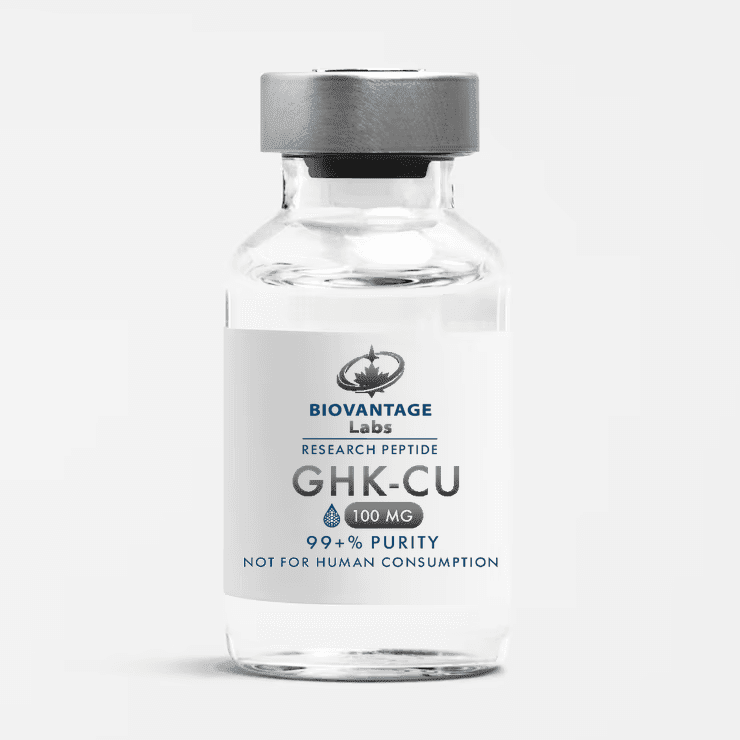
GHK-Cu (Glycine-Histidine-Lysine Copper Complex) is a naturally occurring copper-binding tripeptide studied for its role in collagen and glycosaminoglycan synthesis, wound repair signalling, and antioxidant gene expression in dermal and tissue research models. Biovantage Labs supplies GHK-Cu at 99+% purity, HPLC/MS verified. Domestically fulfilled from Canada. Not for human consumption.
$100.00
GHK-Cu (Glycine-Histidine-Lysine Copper Complex) is a naturally occurring copper-binding tripeptide studied for its role in collagen and glycosaminoglycan synthesis, wound repair signalling, and antioxidant gene expression in dermal and tissue research models. Biovantage Labs supplies GHK-Cu at 99+% purity, HPLC/MS verified. Domestically fulfilled from Canada. Not for human consumption. Biovantage Labs provides this compound at 99+% purity, confirmed by batch-specific HPLC and Mass Spectrometry analysis, as a lyophilized compound for use in controlled laboratory settings.
| Specification | Detail |
| Molecular Formula | C14H23CuN6O4 (copper complex) |
| Molecular Weight | 403.9 Da |
| Sequence | Gly-His-Lys (copper chelate) |
| Purity | ≥99+% (HPLC/MS verified) |
| Physical Form | Lyophilized blue powder |
| CAS Number | 49557-75-7 |
GHK-Cu and AHK-Cu are structurally related copper tripeptides differing by a single N-terminal amino acid substitution (Gly vs. Ala). Research comparing their biological profiles examines whether this substitution produces meaningful differences in receptor interaction, tissue distribution, or biological activity, making the two compounds complementary tools for comparative copper tripeptide biology research.
GHK-Cu is studied for its capacity to upregulate collagen I, III, and IV synthesis in dermal fibroblast models. Research also examines its stimulatory effects on glycosaminoglycan and proteoglycan production components of the extracellular matrix with direct relevance to tissue integrity research.
GHK-Cu demonstrates dual regulatory activity on matrix metalloproteinases (MMPs) in research models stimulating collagen-degrading MMPs while simultaneously upregulating their inhibitors (TIMPs). This balance is studied in the context of physiological tissue remodelling versus pathological degradation.
Gene expression studies have identified GHK-Cu-associated upregulation of antioxidant defence genes including superoxide dismutase and catalase. Research has linked this activity to Nrf2 pathway activation, a master transcriptional regulator of cellular antioxidant responses.
For wound healing and tissue remodelling research examining collagen synthesis signalling alongside repair pathway activation, BPC-157 is studied in adjacent contexts, its FAK-paxillin and VEGFR2-mediated mechanisms representing a distinct but convergent approach to extracellular matrix research.
| Storage Condition | State | Estimated Stability |
| -20°C to -80°C | Lyophilized | 24+ months |
| 2°C to 8°C | Lyophilized | 12 months |
| Room temperature (20°C) | Lyophilized | 3 months |
| 2°C to 8°C | Reconstituted | 7 to 14 days |
Store in a desiccated environment away from UV exposure. Avoid repeated freeze-thaw cycles, which degrade peptide chain integrity over time.
A: The characteristic blue colour results from the copper(II) coordination complex formed between the Gly-His-Lys peptide and a copper ion. The histidine imidazole and lysine amine groups coordinate the copper atom, producing the distinctive chromophore. This colour is an indicator of intact complex formation and is consistent across properly synthesised batches.
A: No. GHK-Cu supplied by Biovantage Labs is strictly for laboratory research purposes. It is not approved for human consumption, veterinary use, or clinical application.
A: Every batch is verified at 99+% purity using HPLC to confirm compound concentration and Mass Spectrometry to confirm molecular identity. Batch-specific COA documentation is available upon request.
A: All Biovantage Labs products are fulfilled domestically from within Canada, eliminating customs clearance risk and reducing transit time compared to international suppliers.
Only logged in customers who have purchased this product may leave a review.


Explore premium-grade peptides for scientific research, purity tested, lab certified, and shipped discreetly.

Automated page speed optimizations for fast site performance
Reviews
There are no reviews yet.