
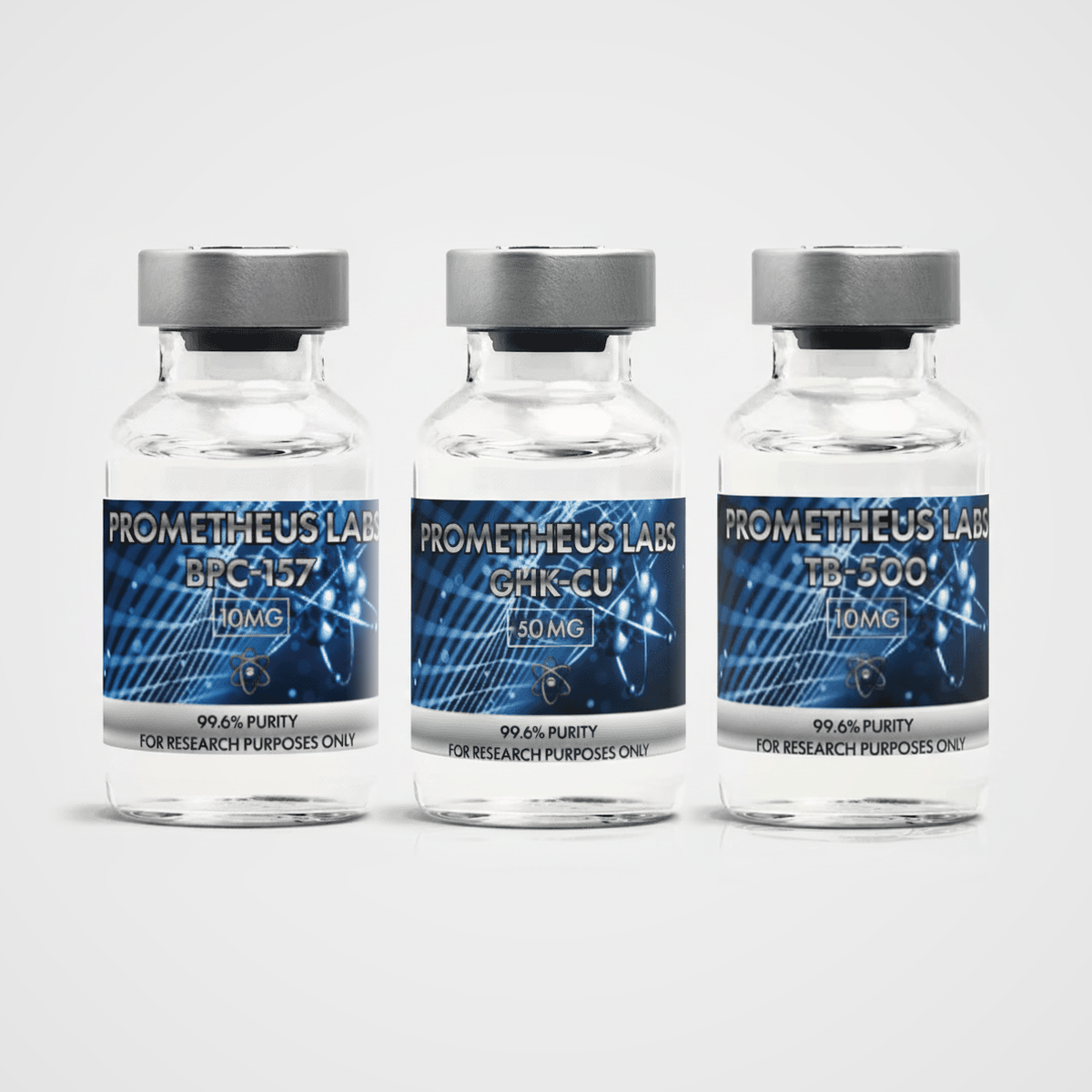
The Glow Blend is a research set of three Prometheus Labs compounds supplied in separate lyophilized vials: BPC-157 10mg, GHK-Cu 50mg and TB-500 10mg. Separate vials let each peptide be reconstituted, added to assays and stored on its own terms. Performance Peptides Canada ships every set domestically within Canada. For in vitro laboratory research use only. Not for human or animal consumption.
$200.00
The Glow Blend is a three-compound research set containing BPC-157, GHK-Cu and TB-500, three peptides frequently studied side by side in cell migration and extracellular matrix research. Prometheus Labs supplies the Glow Blend as three separate lyophilized vials (BPC-157 10mg, GHK-Cu 50mg and TB-500 10mg), shipped from within Canada for laboratory research use only. This page covers what each compound is, why the set is supplied as separate vials rather than a pre-mixed blend, and how to reconstitute and store each one.
The Glow Blend contains three chemically distinct peptides, each in its own vial: a 15-residue synthetic peptide (BPC-157), a copper-binding tripeptide complex (GHK-Cu) and a 7-residue acetylated fragment of thymosin beta-4 (TB-500).
| Compound | Amount | Sequence | Molecular formula | Molecular weight |
|---|---|---|---|---|
| BPC-157 | 10mg | Gly-Glu-Pro-Pro-Pro-Gly-Lys-Pro-Ala-Asp-Asp-Ala-Gly-Leu-Val | C62H98N16O22 | 1419.5 g/mol |
| GHK-Cu | 50mg | Gly-His-Lys complexed with copper(II) | C14H22CuN6O4 | 401.91 g/mol |
| TB-500 | 10mg | Ac-Leu-Lys-Lys-Thr-Glu-Thr-Gln (Ac-LKKTETQ) | C38H68N10O14 | 889.01 g/mol |
All three are supplied as lyophilized powder. Because the compounds differ so much in size and chemistry, the way they are packaged matters, which the next section explains.
Supplying BPC-157, GHK-Cu and TB-500 in separate vials lets researchers treat each compound as an independent variable. Most “Glow” products on the market are a single pre-mixed vial of all three peptides. A pre-mixed vial fixes the ratio between the compounds and makes it impossible to run single-compound controls from the same material. Separate vials allow researchers to:
Working with three vials does mean three reconstitutions, so concentration planning is covered next.
Each peptide in the set is studied in a different area of cell biology, which is why the three are often examined together in the same experimental models.
BPC-157 is a synthetic 15-amino-acid peptide based on a partial sequence of a protein identified in gastric juice. Laboratory research has examined its relationship with angiogenic signalling, including vascular endothelial growth factor (VEGF) pathways, in preclinical models (Seiwerth et al., 2018).
GHK-Cu is the copper(II) complex of the tripeptide glycyl-L-histidyl-L-lysine, first identified in human plasma. Research has focused on its copper-binding chemistry and on gene-expression data showing GHK can influence the expression of a large number of human genes in cell studies (Pickart and Margolina, 2018).
TB-500 is a synthetic, acetylated seven-residue peptide (Ac-LKKTETQ) corresponding to the central actin-binding region of thymosin beta-4, a 43-amino-acid protein that sequesters G-actin. It is studied in actin dynamics and cell motility research (Goldstein et al., 2012). TB-500 is a fragment, not full-length thymosin beta-4.
With each compound’s research context established, the practical step is preparing stock solutions.
Reconstitute each vial separately in sterile water at a defined volume, then label each stock with its concentration in both mg/mL and mM. Because the molecular weights differ by more than three-fold, the same mg/mL gives very different molar concentrations:
| Vial | Volume of sterile water | Concentration | Molarity |
|---|---|---|---|
| BPC-157 10mg | 1 mL | 10 mg/mL | 7.04 mM |
| BPC-157 10mg | 2 mL | 5 mg/mL | 3.52 mM |
| TB-500 10mg | 1 mL | 10 mg/mL | 11.25 mM |
| TB-500 10mg | 2 mL | 5 mg/mL | 5.62 mM |
| GHK-Cu 50mg | 2.5 mL | 20 mg/mL | 49.76 mM |
| GHK-Cu 50mg | 5 mL | 10 mg/mL | 24.88 mM |
Molarity is calculated from the molecular weights in the table above. At equal mg/mL, a TB-500 stock contains about 1.6 times as many molecules as a BPC-157 stock, which matters when comparing the compounds in the same assay.
GHK-Cu identity check: because GHK-Cu is a copper complex, both the powder and its solution have a distinct blue colour. A colourless GHK-Cu solution is a sign the material is not the copper complex. BPC-157 and TB-500 solutions should be clear and colourless.
Once reconstituted, the three stocks have different handling needs.
Store all three vials lyophilized, sealed and frozen until use; once reconstituted, refrigerate each stock and use it within its own working window. Keeping the vials separate means only the compound being used needs to be reconstituted. Allow each vial to reach room temperature before opening to limit moisture uptake, and avoid repeated freeze-thaw cycles by freezing single-use aliquots. For full handling guidance, see the peptide reconstitution and storage guide and lyophilization science.
No. The Glow Blend is supplied as three separate vials: BPC-157 10mg, GHK-Cu 50mg and TB-500 10mg. This allows each compound to be reconstituted and tested independently.
Thymosin beta-4 is a 43-amino-acid protein. TB-500 is a synthetic seven-residue fragment (Ac-LKKTETQ) corresponding to its actin-binding region, with a molecular weight of 889.01 g/mol.
GHK-Cu is a complex of the GHK tripeptide with copper(II), which gives the powder and its solution a blue colour.
Yes. Every Glow Blend set is fulfilled domestically by Performance Peptides Canada, with no cross-border customs clearance.
No. All three compounds are sold strictly for in vitro laboratory research. They are not drugs, natural health products, cosmetics or supplements, and are not for human or animal consumption.
The individual compounds are also available on their own: BPC-157, GHK-Cu and TB-500.
Only logged in customers who have purchased this product may leave a review.


Explore premium-grade peptides for scientific research, purity tested, lab certified, and shipped discreetly.

Reviews
There are no reviews yet.