






Canadian researchers studying metabolic regulation and longevity biology have a growing reason to look at MOTS-c, a peptide encoded not by nuclear DNA, but by the mitochondria themselves. Unlike most compounds in the research peptide space, MOTS-c is endogenous, age-sensitive, and capable of entering the cell nucleus to regulate gene expression directly. This guide covers the mechanism, the published research, and what to verify when sourcing MOTS-c in Canada.
Most compounds in the MOTS-c Canada research space are synthesised exogenously, designed and produced outside the cell, then introduced into a biological system. MOTS-c works differently. It belongs to a class called mitochondrial-derived peptides (MDPs), small proteins encoded not by nuclear DNA, but by the DNA found inside mitochondria themselves.
First identified in 2015 by researchers at the USC Leonard Davis School of Gerontology (Lee et al., 2015), MOTS-c challenged a long-held assumption: that mitochondria were purely energy-generating organelles. The discovery confirmed they also produce signalling molecules that communicate with the rest of the cell, opening an entirely new branch of peptide research.
For Canadian researchers focused on metabolic regulation, longevity biology, and insulin sensitivity, MOTS-c is one of the more active areas of scientific investigation.
MOTS-c is released from the mitochondria in response to metabolic stressors; glucose restriction and oxidative stress are two well-documented triggers. Once released, it acts as a transcriptional regulator, influencing which genes are switched on or off in response to cellular energy demands.
The primary downstream pathway activated by MOTS-c in research models is AMPK (AMP-activated protein kinase), the cell’s core energy sensor. AMPK activation promotes glucose uptake, fatty acid oxidation, and mitochondrial biogenesis. MOTS-c drives this via AICAR accumulation, produced when it inhibits the folate cycle, a pathway central to one-carbon metabolism.
In preclinical studies, MOTS-c has been associated with improved insulin sensitivity and increased glucose uptake in skeletal muscle via GLUT4 transporter translocation, making it relevant to research on metabolic syndrome and insulin resistance biology.
What further distinguishes MOTS-c is its capacity to translocate directly into the cell nucleus under stress conditions. A 2018 study in Cell Metabolism showed MOTS-c entering the nucleus and interacting with chromosomal elements, including antioxidant response element (ARE)-regulating transcription factors, to regulate the stress response, a function not observed to the same degree in other mitochondrial-derived peptides.
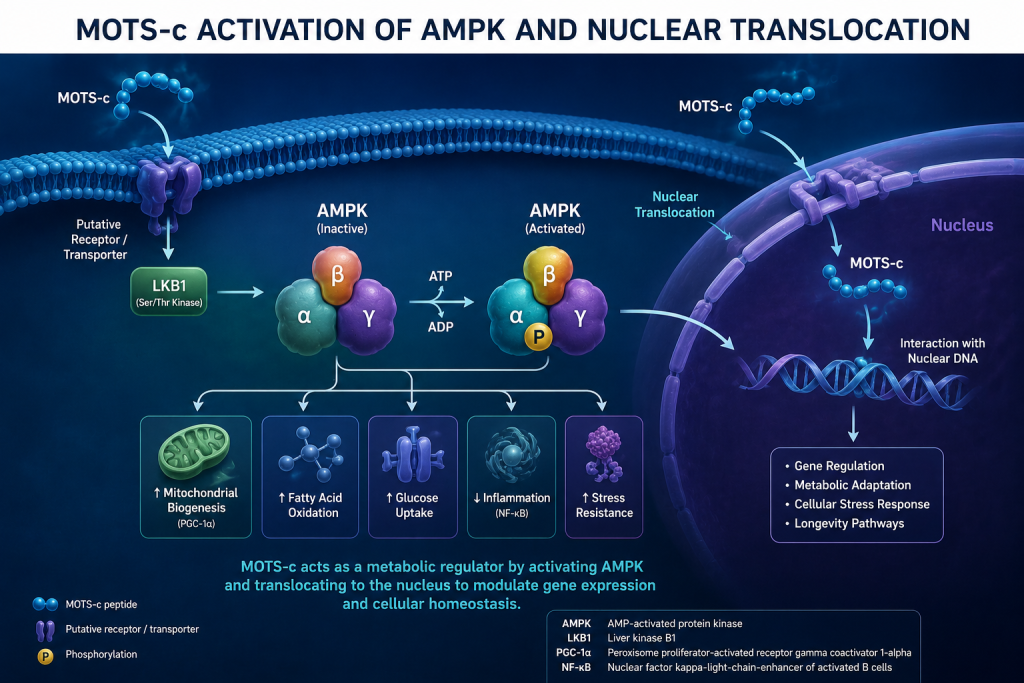
The bulk of published MOTS-c research addresses glucose homeostasis and insulin sensitivity. The 2015 Lee et al. paper reported that MOTS-c treatment in high-fat diet mouse models improved insulin sensitivity and reduced adiposity without caloric restriction. Follow-on studies showed MOTS-c increases GLUT4 translocation, the transporter responsible for moving glucose into muscle cells, in both in-vitro and animal models.
These findings place MOTS-c within active discussions around metabolic syndrome, type 2 diabetes pathology, and obesity biology. None represent clinical conclusions, but they explain the growing research interest in this compound over the past decade.
Researchers sourcing MOTS-c in Canada can review batch-specific purity data on Performance Peptides Canada’s verify batch-specific purity data for MOTS-c, where COA documentation is available for every lot.
Two other mitochondrial-derived peptides draw research attention:
Both are encoded in the same mitochondrial 12S rRNA region as MOTS-c.
What sets MOTS-c apart is its nuclear translocation capacity, the ability to enter the cell nucleus and regulate gene expression directly. Neither Humanin nor SHLP2 demonstrates this function at the same level in published research. That makes MOTS-c the most mechanistically complex of the three, and the one with the broadest potential applications across metabolic and longevity biology.
MOTS-c is supplied in lyophilised (freeze-dried) form, the standard presentation for high-purity research peptides. Store at -20°C in a sealed, light-protected environment; under these conditions, the compound remains stable for 24+ months from manufacture. Once reconstituted in bacteriostatic water, store at 4°C and use within the timeframe specified on the batch COA. Avoid repeated freeze-thaw cycles, which degrade compound integrity.

MOTS-c is less widely stocked than BPC-157 or TB-500, and purity documentation from international suppliers is often inconsistent. When evaluating any Canadian supplier, these criteria are non-negotiable:
Performance Peptides Canada supplies MOTS-c under the Biovantage Labs brand with independent HPLC + MS third-party testing, batch-specific COA download on every product page, and 100% domestic Canadian fulfillment from climate-controlled facilities.
MOTS-c occupies a genuinely distinct position in the peptide research landscape. It’s endogenous, mitochondrially encoded, and age-sensitive, a combination no exogenous compound can replicate.
Published research supports its role as a metabolic regulator via AMPK activation and as a nuclear communicator under stress. Circulating MOTS-c also declines with age and rises transiently with resistance exercise (Zhu et al., 2021), an important variable to account for when designing longevity or exercise physiology study protocols.
Significant mechanistic work remains before these pathways are fully characterised in human biology. For Canadian researchers working in metabolic science, longevity biology, or mitochondrial function, MOTS-c is one of the most active and well-documented areas in the mitochondrial-derived peptide space, and one of the most worth tracking as the research matures.
Research Use Only: MOTS-c supplied by Performance Peptides Canada is intended exclusively for in-vitro laboratory and independent scientific research. It is not approved for human use and must not be used for self-administration, clinical treatment, or any purpose outside of research. All research should comply with applicable Health Canada guidelines.
MOTS-c is a narrow-availability compound, and purity documentation from non-domestic suppliers is frequently inconsistent. Performance Peptides Canada supplies MOTS-c with independent HPLC + MS third-party verification, lot-traceable COA download on every product page, and 100% domestic Canadian fulfillment from climate-controlled facilities.
No customs risk. No cold-chain uncertainty. Verifiable documentation for every shipment.
MOTS-c is a mitochondrial-derived peptide encoded by mitochondrial DNA, not nuclear DNA. Most research peptides are synthetically designed from exogenous protein sequences. MOTS-c is unique because it’s produced naturally inside the mitochondria in response to metabolic stress, and it can travel into the cell nucleus to regulate gene expression directly.
In preclinical models, MOTS-c has been associated with AMPK activation, improved insulin sensitivity, increased GLUT4-mediated glucose uptake in skeletal muscle, and modulation of the one-carbon metabolic pathway. These are preclinical observations, they don’t constitute clinical outcomes, but they’ve driven substantial research interest into metabolic syndrome and insulin resistance biology.
MOTS-c is not currently listed in Health Canada’s active compound advisories, unlike BPC-157, TB-500, CJC-1295, and Ipamorelin. It is supplied in Canada strictly for in-vitro research and laboratory use only.
Store lyophilised MOTS-c at -20°C in a sealed container, protected from light and moisture, stable for 24+ months under these conditions. Once reconstituted, refrigerate at 4°C and use within the timeframe specified in the batch COA. Avoid repeated freeze-thaw cycles, which degrade compound integrity over time.
Performance Peptides Canada provides batch-specific COAs, verified by independent HPLC and MS testing as downloadable documents on every product page. These are lot-specific records, not generic certificates.