
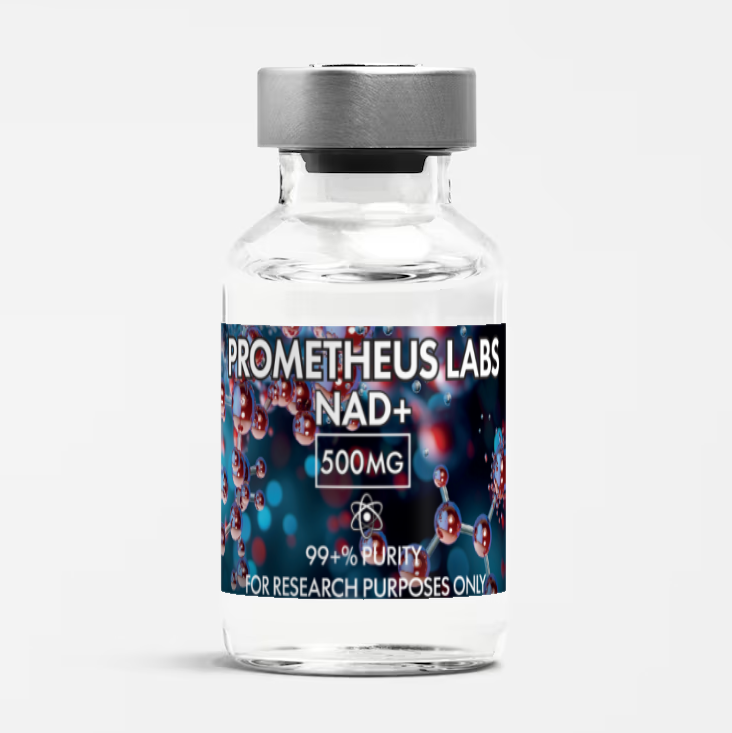
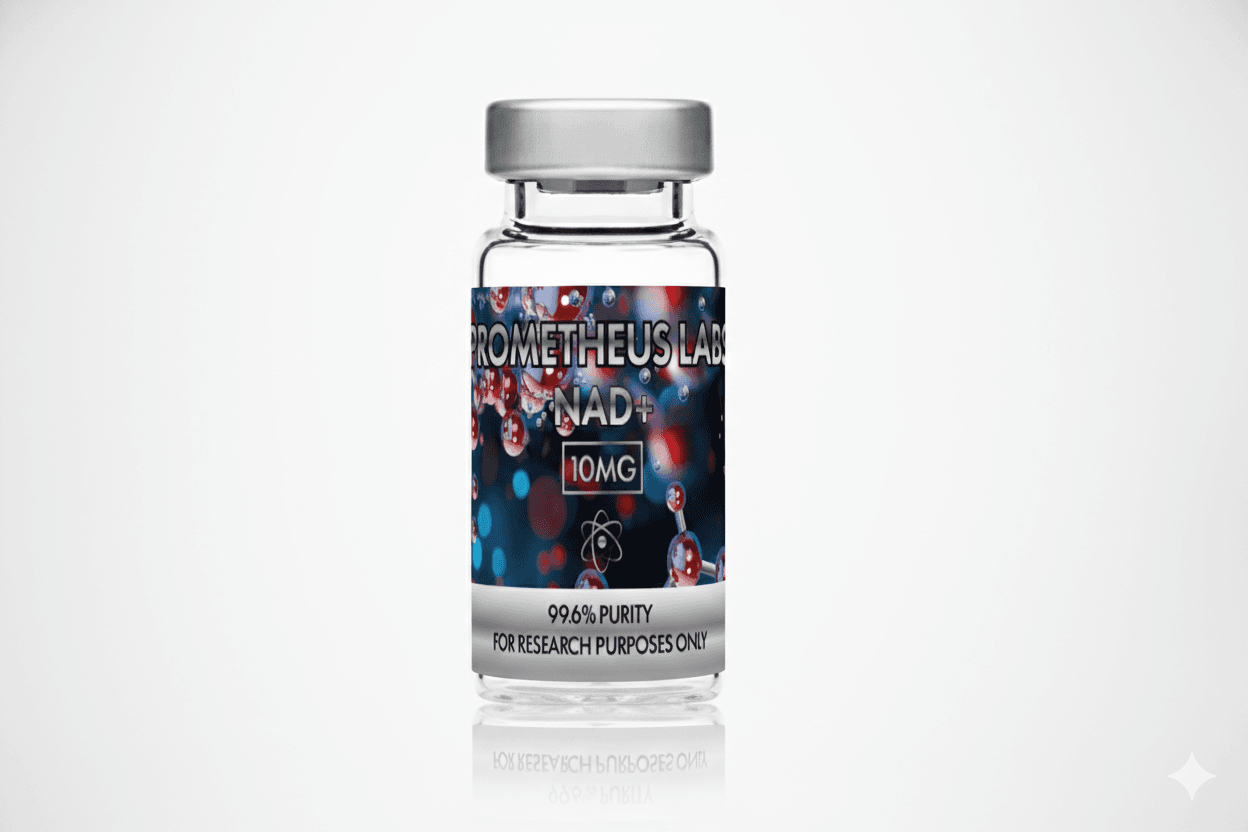
NAD+ (nicotinamide adenine dinucleotide, CAS 53-84-9) is a dinucleotide coenzyme studied as a redox cofactor and as the substrate for sirtuins, PARPs and CD38. Prometheus Labs supplies NAD+ as a lyophilized white powder in 500mg and 1000mg vials, and Performance Peptides Canada ships every order domestically within Canada. For in vitro laboratory research use only. Not for human or animal consumption.
$150.00 – $250.00Price range: $150.00 through $250.00
NAD+ (nicotinamide adenine dinucleotide) is a dinucleotide coenzyme present in every living cell, where it carries electrons in redox reactions and serves as a substrate for NAD+-consuming enzymes. Performance Peptides Canada supplies NAD+ as a lyophilized research compound in 500mg and 1000mg vials, shipped from within Canada, for laboratory research use only. This page covers its chemical identity, its role in published research, how to prepare and verify a stock solution, and how to store it.
NAD+ is the oxidized form of nicotinamide adenine dinucleotide, a coenzyme built from two nucleotides (one containing adenine, one containing nicotinamide) joined by a pyrophosphate bridge. It is not a peptide: it contains no amino acids, which is why its handling requirements differ from the peptides in our catalogue.
| Property | Value |
|---|---|
| Name | Nicotinamide adenine dinucleotide, oxidized (NAD+) |
| Molecular formula | C21H27N7O14P2 |
| Molecular weight | 663.43 g/mol (free acid); 685.41 g/mol (sodium salt) |
| CAS number | 53-84-9 |
| Physical form | Lyophilized white powder |
| Vial sizes | 500mg, 1000mg |
Because NAD+ is chemically distinct from peptides, the way researchers use it in experiments also differs, which the next section outlines.
In laboratory research, NAD+ is studied as both a redox cofactor and a consumed substrate. As a cofactor, NAD+ accepts electrons in glycolysis and the tricarboxylic acid (TCA) cycle and is reduced to NADH, which passes those electrons to the mitochondrial electron transport chain. The NAD+/NADH ratio is therefore a common readout of a cell’s redox state.
As a substrate, NAD+ is cleaved by three enzyme families that researchers study closely:
Published reviews report that tissue NAD+ levels decline with age in rodent and human studies, which has made NAD+ metabolism a focus of ageing research (Covarrubias et al., 2021; Verdin, 2015). Since these experiments depend on knowing exactly how much NAD+ is in solution, stock preparation is the next consideration.
To prepare an NAD+ stock solution, dissolve the lyophilized powder in sterile water at a defined volume, then confirm the concentration by UV absorbance. NAD+ is highly water-soluble and should dissolve with gentle swirling; avoid vigorous shaking.
NAD+ is supplied as a lyophilized powder either as the free acid (663.43 g/mol) or as a sodium salt (685.41 g/mol). Both look identical as a white freeze-dried powder, so the table shows the molarity for each:
| Vial | Volume of sterile water | Concentration | Molarity (free acid) | Molarity (sodium salt) |
|---|---|---|---|---|
| 500mg | 10 mL | 50 mg/mL | 75.4 mM | 72.9 mM |
| 500mg | 20 mL | 25 mg/mL | 37.7 mM | 36.5 mM |
| 1000mg | 20 mL | 50 mg/mL | 75.4 mM | 72.9 mM |
| 1000mg | 40 mL | 25 mg/mL | 37.7 mM | 36.5 mM |
The difference between the two forms is about 3%. Measuring absorbance, described below, gives the exact molarity of the prepared stock regardless of form.
NAD+ can be quantified independently with a standard UV spectrophotometer:
Once the concentration is confirmed, how the solution is stored determines how long that figure stays accurate.
Store lyophilized NAD+ desiccated at −20 °C and protected from light; once in solution, refrigerate for short-term use or aliquot and freeze. The solid is hygroscopic, so keep the vial sealed until use and allow it to reach room temperature before opening to limit moisture uptake.
| Form | Condition | Guidance |
|---|---|---|
| Lyophilized solid | −20 °C, desiccated, dark | Recommended long-term storage |
| Solution, neutral pH | 2 to 8 °C | About one week |
| Solution | −20 °C, single-use aliquots | Longer-term storage; avoid repeated freeze-thaw |
| Solution, alkaline pH | Any | Degrades rapidly; avoid |
Supplier technical data for β-NAD reports that solutions decompose at alkaline pH and are stable for about one week at 4 °C at neutral pH (Sigma-Aldrich). Planning storage around experiment length also helps when choosing between the two vial sizes.
The 500mg vial suits single studies and method development, while the 1000mg vial suits longer series run from one batch. Running a full study series from a single 1000mg vial removes batch-to-batch variation as a variable. For smaller studies, the 500mg vial limits the amount of reconstituted material that has to be stored. Both sizes are supplied as the same lyophilized compound and ship domestically within Canada, so there are no cross-border customs delays (see domestic shipping vs customs in Canada).
No. NAD+ is a dinucleotide coenzyme made of two nucleotides joined by phosphate groups. It contains no amino acids, so it is not a peptide, although it is often studied alongside mitochondrial peptides such as MOTS-c and SS-31.
NAD+ is the oxidized form that accepts electrons; NADH is the reduced form that donates them. They can be told apart by absorbance: only NADH absorbs at 340 nm.
Yes. All NAD+ orders are fulfilled domestically by Performance Peptides Canada, with no cross-border customs clearance.
No. This product is sold strictly for in vitro laboratory research. It is not a drug, natural health product or supplement, and is not for human or animal consumption.
For general handling guidance across our catalogue, see the peptide reconstitution and storage guide and lyophilization science.
| Weight | 500mg, 1000mg |
|---|
Only logged in customers who have purchased this product may leave a review.


Explore premium-grade peptides for scientific research, purity tested, lab certified, and shipped discreetly.

Reviews
There are no reviews yet.